Walk the Line: A Visit to the Equator

North and South of the Equator

North and South of the Equator

Who can resist the draw of standing on the equator? Matt and I couldn’t, so one Sunday we set off from Quito to go to Mitad del Mundo, “the Middle of the World.” We intended to take a cheap bus there, but for some reason, despite directions, couldn’t figure out where to catch the bus. So we settled for a $15 cab ride to drive us the 1/2 hour to the site. After some confusion (apparently the theme of our day) we realized that the building we, and a bunch of other people, were hanging around was just the Unasur (Union of South American Nations) building, and was not getting us closer to standing on the equator! We headed over to the ticket booth, which was inexplicable chaos. There were some people waiting, but nothing like a Milwaukee Summerfest crowd. The delay seemed to be because newcomers would conveniently not see the lines and just pop ahead of all of us waiting. Eventually, I had enough of this nonsense and skipped ahead of the skippees to the front of a line.

We were in at last. Our full tickets included the planetarium, and we were urged several times to go directly to the planetarium. We took a quick photo or two on the equator, rushed to the planetarium… and waited in line for about 40 minutes. The show was in Spanish, and while I understood a decent amount of it, a nap seemed more in order. Frankly, apart from the Little and Big Dippers, Southern Cross, Orion’s Belt (but not the whole guy) I can never see the constellations – it’s a bunch of dots and a lot of imagination to me!

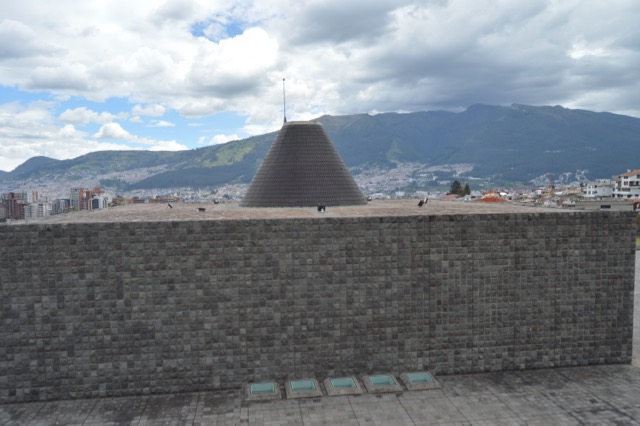
We headed to the monument and went to the top to enjoy the views and the sight of the equatorial line running across the premises.

Now here is the rub: the monument is in the wrong spot and we were not actually at the equator! We knew that before entering the complex, but decided to check out the spectacle all the same. And a spectacle it was. The monument also houses a nice museum showcasing the indigenous cultures of Ecuador, and the grounds have tons of souvenir shops, restaurants, a couple other museums and even some entertainment, all devoted to the wrong spot on the map. I find it hilarious that although modern GPS proves the equator to be about 240 meters north of this line, this entire complex pretends that isn’t the case. Not a disclaimer anywhere that you aren’t on the real deal. Apparently the motto is “Why be right if people will pay anyhow?” And indeed, we did!
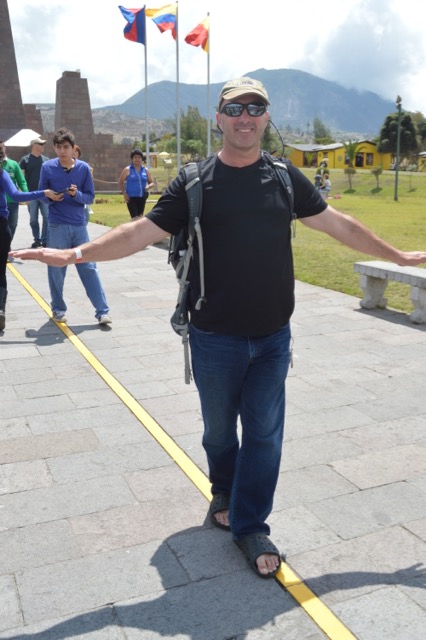
Walk the Line

Walk the Wrong Line

But then we walked down the road to the real equator, at the Intiñan museum. Privately owned (yes, the incorrect location is owned by the local government), the Intiñan museum was hokey but charming.

We were told to wait for an English tour, but a mountain storm was brewing so we tagged along on a Spanish tour, which we quickly ditched when we realized it was going to take us through little exhibits of the different regions of Ecuador. We just wanted to stand on the equator. And so we did.

Matt didn’t try, but I was determined to balance the egg!

All in all, a fun, silly time. Especially when you consider that the equator is a line and certainly there are other spots in the area on which one could cross it.

We tried for a picture proof, but because our phone GPS is not military grade, this was as close as we could get.

As close as we could get on our GPS

As close as we could get on our GPS

Art and the City

I admit that I had never heard of Oswaldo Guayasamin, Ecuador’s most famous painter, before we arrived in Quito.

Self Sculpture

Self Sculpture

Born in poverty in 1919, Guayasamin devoted his artwork to portraying indigenous people, racial discrimination, injustice, violence and the plight of the poor. Powerful stuff. One of his famous quotes is “I cried because I had no shoes until I saw a child that had no feet.” The Fundacion Guayasamin site contains the artist’s former home and studio (he died in 1999) with its breathtaking mountain views, a museum called La Capilla del Hombre (Chapel of Man) that Guayasamin designed before his death and, as an added bonus, a small archeological site. It was amazing. An absolute must-see for anyone visiting Quito.

Mural

Mural

The exterior of La Capilla del Hombre is bunker-esque, but inside the space is perfect, just as the artist envisioned.

La Capilla de Hombre

La Capilla de Hombre

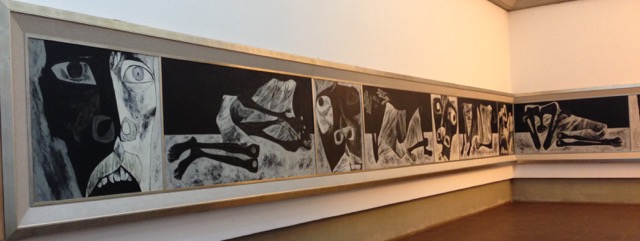
The Capilla del Hombre is a tribute to man, in particular the struggles and sufferings of Latin Americans. The museum has an eternal flame on the ground floor that represents a prayer for peace and human rights. Matt snuck some pictures.

Suffering

Suffering

While it was definitely our favorite museum, we also enjoyed other museums and artwork around the city.

Wheelie Art:

The National Museum of Quito is housed in a complex that includes theaters and a few other museums and has some cool outdoor art. Pictures are forbidden in the museum (this time Matt complied) but the works ranged from pre-Colombian pottery and the like to religious art from the Colonial era.

In the same complex is a modern art museum and we stopped in and enjoyed some work of Francisco Urquiza. I have no idea who he is but his paintings were really cool!

Another museum visit, to the Casa De Alabado, was also well worth it although we again have no pictures to share. It had pre-Colombian artwork of the indigenous cultures. Finally, we enjoyed the Museum of Contemporary Art. Housed high on a hill overlooking the city in an old military hospital, the museum has rotating exhibits. We saw three: a student photography exhibit, an Italian exhibit of art from the 1960s (psychedelic, baby!) and Art in Orbit, devoted to outer space. Art in Orbit included a room at the end, complete with bean bag chairs, where one could watch various sci-fi movies.

I loved the room of gowns by Italian designer Fausto Sarli. Che Bello!

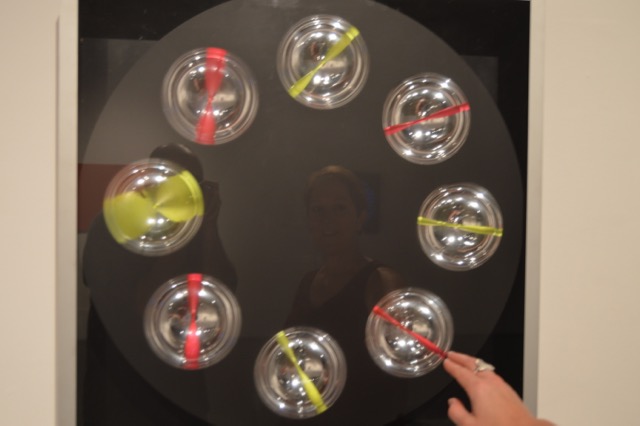
The 60s art was dizzying with its play on dimensions. This piece was awesome and photographed pretty well. It was 2D but the pixie stick lines looked real!

2 Dimensional, but looks 3D!

2 Dimensional, but looks 3D!

And last, but not least, if you can’t make art, join it!

Photo Bomb

Photo Bomb

Quito – the City that Grew on Me

We have passed the 3 week mark in Quito, Ecuador. While this isn’t ideal and we would rather be getting on with our new life on the Galapagos Islands, there are worse places to spend a few weeks as you wait for your visas. Well, not just visas: we finally got those last week but now need the special permission to live on the Galápagos Islands. Nothing seems to be going easily, but we are trying to enjoy our time despite the frustration of waiting.

Relaxed

Relaxed

Quito is situated in the Andes at 9,350 feet above sea level. That hasn’t posed a problem for us because we were used to living in the Andes in Cajamarca. For a capital city with a population of about 2.6 million, Quito feels surprisingly accessible. We are staying in an apartment (thank you, Airbnb) in the Mariscal Foch area, which is a great location for us. We can walk to a number of parks, restaurants, malls, the Old Center etc. Initially Quito did not rock my world – it was nice but not spectacular. However, the more time we have been here, the more I appreciate it. (Except the food. Peruvian food is much better.) A mountain view anywhere you look is a selling point.

View from the Apartment

View from the Apartment

One of my favorite things about Quito is the many parks. We have walked through Carolina, Ejido, Arbolito and Alameda parks several times. It’s a toss up which is my favorite. Ejido and Arbolito Parks appear to be one park and have a lot of trees (hence the name “Arbolito” or “Little Tree”), making for a nice walk. All of the parks are well used by families, couples, groups of people and, as we saw yesterday, card players. I didn’t get a picture, but it cracked me up – crowds of men around an overturned box, cash flying. Initially we thought it was a shell game but then we saw the cards. I’m not sure what game is being played or whether my assumption is correct that it is illegal, but I am intrigued.

Park Carolina is a ginormous park. It has a running track, soccer fields, lagoon, old airplane, and, my favorite part, a wonderful botanical garden. I have dragged a somewhat reluctant Matt to botanical gardens everywhere we have visited and he agreed this one was the best. It might have been because the weather was perfect – low 70s and partly cloudy (key at the equator) – so it was pleasant to stroll around. There were many different exhibits and 2 greenhouses: one devoted to carnivorous plants and one to orchids. I wanted to see a bug get eaten in the Carnivorous greenhouse, but no such luck.

The Orchid Greenhouse contains over 1,200 Ecuadorian species of orchids and is a highlight of the gardens.

Our walks in the parks have been educational and relaxing. Not a bad way to pass the time.

Next Up: Great Museums and The Middle of the World!

Beautiful Basilica de Voto Nacional

“Are these people nuts?” It seems that I ask this question frequently in South America although not often in a church. I am looking at a rickety, unenclosed, 3 story ladder (unless you count the netting and I do not) that leads to the top of the one of bell towers of the magnificent Basilica de Voto Nacional in Quito. A stiff wind is blowing and as I watch, a septuagenarian makes the very wise decision to turn around and descend the ladder on her rear. There is a line of people waiting to ascend and the look of horror on my face makes it clear that I am not planning the climb. Another lady confesses that she made it three steps and had to turn back. I console myself with the fact that the view from the base of the bell tower is fantastic and causing an international incident by getting stuck on the ladder isn’t really necessary. While I am a wimp when it comes to climbing – actually descending – open staircases, this climb isn’t for the faint of heart. The Basilica sits high atop a hill in the city and the towers are 377 feet high.

Basilica de Voto Nacional

Basilica de Voto Nacional

The funny part is that I didn’t feel that the rest of our climb around the Basilica was particularly safe. On the second story balconies we had to climb across crumbling corners and navigate electrical cords everywhere. Guardrails? Please. Apparently, your faith will protect you from harm! But touring the Basilica was well worth the risk – it is as spectacular as its views. It is patterned after Notre Dame and the Gothic design is fantastic. My favorite part was the native species gargoyles although the brilliant stained glass was a close second. The nave itself is unfinished and a bit cold feeling, but there is a small chapel, La Capilla de Sacramento, that is stunning in its decoration. Unfortunately, photos are not permitted in the Chapel.

Pope John Paul II blessed the Basilica in 1985 and this welcoming entrance was one of my favorite parts of the building.

Pope John Paul II

Pope John Paul II

A Great Good Friday in Quito

I was having flashbacks to my Catholic school upbringing. I had stumbled into the courtyard of the Basilica del Voto Nacional on Good Friday and discovered a live enactment of the Stations of the Cross. It was odd – tourists were crowded about, taking pictures and videos, teenagers were cracking up over the fake whippings with ketchup used as blood, no one seemed to be relating the spectacle to the event. But as I watched longer, it seemed appropriate – a crucifixion was entertainment in its day, not unlike the horrific public stonings or executions in other countries in the present day. Or maybe that was just my excuse so we could take pictures too.

Welcome to Good Friday in Quito, Ecuador. A mix of sacred and carnival, Quito has a Good Friday Procession, Jesus del Gran Poder (Jesus of Great Power), that draws thousands for the 4 hour event. Many of the faithful dress in the purple robes and cucuruchos (cone hoods) of the penitent. Others dress as Jesus or Veronica, the woman believed to have wiped Jesus’s face, or Roman soldiers. Many carry crosses, some whip themselves with stinging nettles or have them wrapped around their bodies, the red welts apparent, and others have barbed wire wrapped around themselves, eating into their flesh. The parade also includes priests broadcasting sermons and prayers and marching bands. It is quite a spectacle.

View of the Procession and Virgen De Quito from the Cathedral

View of the Procession and Virgen De Quito from the Cathedral

Many of the crosses are huge and carried by several people. They stagger a few yards with the cross before dropping it with a thud.

Over halfway through the procession, we saw this father and son on a side street getting dressed to join the procession.

Also notable were the number of children in the parade. Just what did they have to be so penitent about?

This man also seemed to have suffered enough in his life.

Injured Cross Carrier

Amputee Cross Carrier

After the procession we enjoyed another Semana Santa (Holy Week) tradition: Fanesca. A special soup made only for Semana Santa it contains 12 grains and milk and is served with salted cod, boiled egg, fried plantains, slices of peppers, fried empanadas, fried empanada dough (masitas) and fresh cheese. The proprietors of the restaurant in which we ate were very friendly, eager to explain the special nature of the soup to us and concerned that we were happy with our meal. We were – it was delicious and filling.

The Wait Is Over – Galapagos, Here We Come!

I started writing this post before Matt secured his job as director of the Tomás de Berlanga school on Isla Santa Cruz in the Galapagos Islands, Ecuador. When I saw it in the archives it brought back all of the uncertainty we were feeling at the time, which continues in a reduced form to the present time as we hang out in Quito waiting for our visas to be processed, with our belongings somewhere in Lima, waiting to be shipped to us.

The waiting is the hardest part. Okay, that probably isn’t true for Matt. For me, it’s the hardest part: wondering where we will be moving, where Matt will find a job. For Matt, the hard part is the endless interviewing, selling himself multiple times a week and sometimes multiple times a day.

For our time at Davy School and in Peru is coming to an end. Unfortunately, within a few months of our arrival in Cajamarca in July 2013 the mine that funded that school announced it was cutting its support by 50% in 2014 and 2015 and then exiting the school business altogether by 2016. Matt’s expat salary, and those of the other expats, was an obvious place to cut costs. While the school would honor the contracts, the sooner we all left, the better. Matt’s contract is up July 2015, so this provided ample time to find a job.

I realize that many, many people have been involuntarily without work, but it was a first for both Matt and me. I also realize that he has had several months of lead time to start looking for a job, which is a luxury most people don’t have. But we don’t have a home. We sold everything when we decided to embark on the this expat life. We live in Peru because Matt’s job is here, but as soon as his job ends, his work visa is revoked and we need to leave. Where will we go?

So in August Matt began applying for jobs that were opening in January (Davy would be thrilled to release him from his contract) or July. Our geographical parameters were broad: South and Central America, most of Southeast Asia, Europe, Taiwan and Hong Kong. For political, safety and assorted reasons, the Middle East, Africa and Mainland China were off our list, as was Venezuela. And so the interviewing began. We didn’t keep track, but Matt made it to the “semi-finals” for several schools. It was exhausting for both of us. With every round of interviews we speculated endlessly. This one was the place, the location of our dreams. We would research weather, apartments, safety, etc. in an effort to convince ourselves that it was meant to be. Then, once we reached a comfort level and got enthusiastic over the possibility, Matt wouldn’t get the job. And on we would move to another part of the world.

But then, it happened. In February Matt received a tentative offer for a school in the Galapagos Islands and an invitation for both of us to visit. So we went. Matt was instantly sold; I was not. I don’t know what I was expecting, but Puerto Ayora wasn’t it at first glance. It was, well, sort of Peruvian, but very expensive. Not the resort island I had expected.

The next day I walked to this beach. And fell in love.

The beaches aren’t the only highlight of the Galapagos. The Darwin Research Station is pretty amazing too.

The highlight of our initial visit to The Station, as it is called, was the Giant Tortoise fight. One tortoise appeared to be the aggressor and would saunter over to the other tortoises, stick its head out and then sort of bite one of the others. The other one would sloowly back away and then the first one would lie down for awhile before starting over. It may not sound like a Tyson-Holyfield bout, but let me tell you, it was pretty darn entertaining!

Another favorite spot was Las Grietas, which translates not very well as”The Cracks”, a deep chasm of volcanic rock with unbelievably blue, cool, fresh water. The trip requires a water taxi to “the other side” of the island and a nice walk to Las Grietas, but it is well worth it despite the crowds. Apparently there is a hole somewhere in the cliff and you can dive down into another pool. We plan to try it with our new snorkeling equipment.

So in the end, we are both delighted to be moving to Puerto Ayora, Isla Santa Cruz, Galapagos Islands, Ecuador. And the adventure continues…

Paradise

Paradise

The Long Reach of the IRS

Filing taxes isn’t fun for anyone, but I am an idiot when it comes to forms. So for years Matt handled our taxes using Turbo Tax. I would review them, make a few corrections (Turbo Tax isn’t perfect) and generally the process was pretty painless. Then came 2013 – the year we moved abroad.

The United States and Eritrea (no clue where that is) are the only two countries in the world that impose income taxes on the foreign income of non-resident citizens. To the surprise of many expats, this means that even if you have lived abroad for many years and have made no money on US soil, your foreign income is subject to US income tax and you have to file a tax return.

I will spare you the tax details, but in general if you are an expat you are allowed to exclude a certain amount of your expat income from taxation if you meet one of two foreign residency tests. One of the tests – physical presence – we couldn’t meet in 2013 because we spent too much time in the US that year so we had to get an extension to file our 2013 taxes in 2015 – after we lived in Peru for a calendar year.

So last December I sat down to work on the 2013 taxes we would be filing in January. I gathered all of Matt’s Davy pay stubs, actually figured out what everything meant on them, pulled up our W2s from our US jobs in 2013 and logged onto Turbo Tax. Denied! No computer system is available for taxes after October of the filing year, even though we had an extension. Thus began about 80 hours of reading tax forms, IRS guidance, and occasionally IRS regulations all in an effort to figure out how to determine our stinking taxes. I discovered that given our situation of both US income and Peruvian income I actually needed to figure out our taxes using 3 different methods. By hand. It was worth it because under one method we owed about $6,000 and under another, we had a $1,600 refund. Guess which one I chose!

We don’t have a printer here, so at one point in this process, I decided to go to an internet cafe to print off the forms and some of the tax instructions because I needed to complete the various worksheets on them. I had never been in one because we have internet in our home, but they are usually packed with kids playing computer games. This day was no exception although the occasional businessman stopped in, presumably to check email (or surf porn, who knows). It took me awhile to figure out the process, but in the end I had to download the documents I wanted to a drive and then go up to the clerk and ask him to open and print the documents for me. At one point he had to send a kid out for more paper and the kid returned with about 100 sheets – not a full ream, mind you! After about an hour I had about 60 pages of what I needed and called it a day.

Once in Wisconsin, I finished up the Wisconsin return and then encountered my next glitch – the paper size in Peru is slightly different than in the US so scanning and copying wasn’t working properly. After several meltdowns the returns were in the mail. But the fun wasn’t done.

First, the Wisconsin Department of Revenue ignored both the address on our tax return and the cover letter indicating our address and sent our refund to our old home, which we haven’t owned for over a year and a half! Thankfully, the kind new owner tracked me down via social media and got the check sent to Matt’s mom’s house for us. Today, after being on hold for over an hour, I learned that the IRS decided to mail our refund to us in Peru despite the fact that I provided bank information for direct deposit and a cover letter indicating that any correspondence should be sent to Matt’s mom’s house. ARGG. It’s anyone’s guess whether we will ever see that check because mail does not get delivered here, so now we will have to periodically trek to the post office to see if it has arrived. Only after a month can we ask the IRS to “investigate” what happened.

But I did learn from all of this. Our 2014 taxes were filed using Turbo Tax today. It was still several hours of work to tell the IRS we don’t owe them any money, but at least is is done. I hope.

To Flush or Not to Flush

After 3 weeks in the US and almost a week in Panama City, Panama, we were back in Peru. I was reminded of this the minute I stepped into the ladies’ room at the airport.

Don't Flush the TP

Don’t Flush the TP

Yep, you read that correctly. Don’t flush the toilet paper. In the toilet. These signs are prevalent in Peru, but I have to admit – even if I am reading the sign, the TP often goes right in the toilet. Why? Because it’s toilet paper. As Matt said, it is not called poopy paper: it is specifically designed to be flushed. So my practice is that if there is a sign, I do my best to override 44 years of toilet training and throw the paper in the trash can. But if there is no sign, all bets are off and in the toilet the paper goes.

But I was never really sure about the propriety of my actions. Every private home also has a covered garbage can in the bathroom, but I preferred to assume this was to throw out Kleenex and the like. Unfortunately, when we rented our very nice vacation apartment in Lima, a similar sign reared its ugly head. I pointed it out to Matt. “Ugh, no way,” was his reaction. After I mentioned that he would be the one plunging any blocked commode, we both did our best to comply. Gross.

One evening over drinks, I asked our Peruvian friend Korinne about the proper etiquette. “So, if I am at someone’s house, can I flush the toilet paper?” I casually worked this question into our conversation. She was aghast. “No, it wouldn’t be polite!” The horrified look on her face was priceless. It was as though I had asked if I could poop on the floor. Matt sought clarification, “So it is more polite for me to put shitty paper in your garbage can?” “Yes, of course.”  She sought to clarify: “The pipes aren’t very big and can get blocked.” This makes sense with objects apart from toilet paper. We all know the yahoo who ran out of TP and thought a napkin or paper towel would suffice. Or maybe if the home was old and had poor plumbing. But Korinne didn’t budge.

So now I know. And wish I didn’t.


Selling a Cow to Buy a Computer

My housekeeper, Maria, asked me about a month ago if I could bring back a laptop from the US for her nephew. He is hoping to study engineering next year and the family thought it would be beneficial if he got a computer. While he could buy a laptop here, apparently the prices are much better in the US. Generally Matt and I decline to bring back electronic items for people because we don’t want the responsibility or the potential to have to pay import taxes on it when we return to Peru. And because I am usually using a kitchen scale to stuff the last permissible 6 ounces into my luggage. But given that Maria’s family is not wealthy and would not have access to other people traveling to the US, I agreed to help her out.

Magnificent Maria

Magnificent Maria

I asked Maria what computer her nephew wanted. He didn’t know and she suggested that I just pick one out for him – they trust me. Are they kidding? I know nothing about computers except that I pitch a fit when ours doesn’t work properly and whine to Matt until he solves my problem. I suggested that her nephew talk to friends, someone at the university – basically anyone but me. I did contact my nephew, a US college student, to enlist his aid. He came up with a couple of low cost options and I presented them to Maria along with website addresses for her nephew to review them. (Now I know you are thinking, “but Kerry, her nephew doesn’t have a computer, you idiot.” Rest assured that there are internet cafes, and I am using the word cafe very loosely, all over our town.) And I heard nothing more about it.

Now Peruvians tend to bring up important matters at the last minute. I let the computer issue rest for awhile because I really didn’t want to be responsible for bringing one back with us. But I adore Maria and I knew she felt awkward asking the favor in the first place, so last week I asked if her nephew had decided on a computer. The response? “Well, it depends on whether they can sell a cow.” What?! The long and the short of it was that her brother needed to sell a cow to get the money for the computer. He took the cow to the market but the prices were just too low. The family suspects the low prices are because everyone is saving their money to buy turkeys for Christmas, so beef is not in demand. He tried again this past weekend, but the prices were still too low and he couldn’t take the loss on the cow. So Maria’s nephew won’t be getting a computer this Christmas.

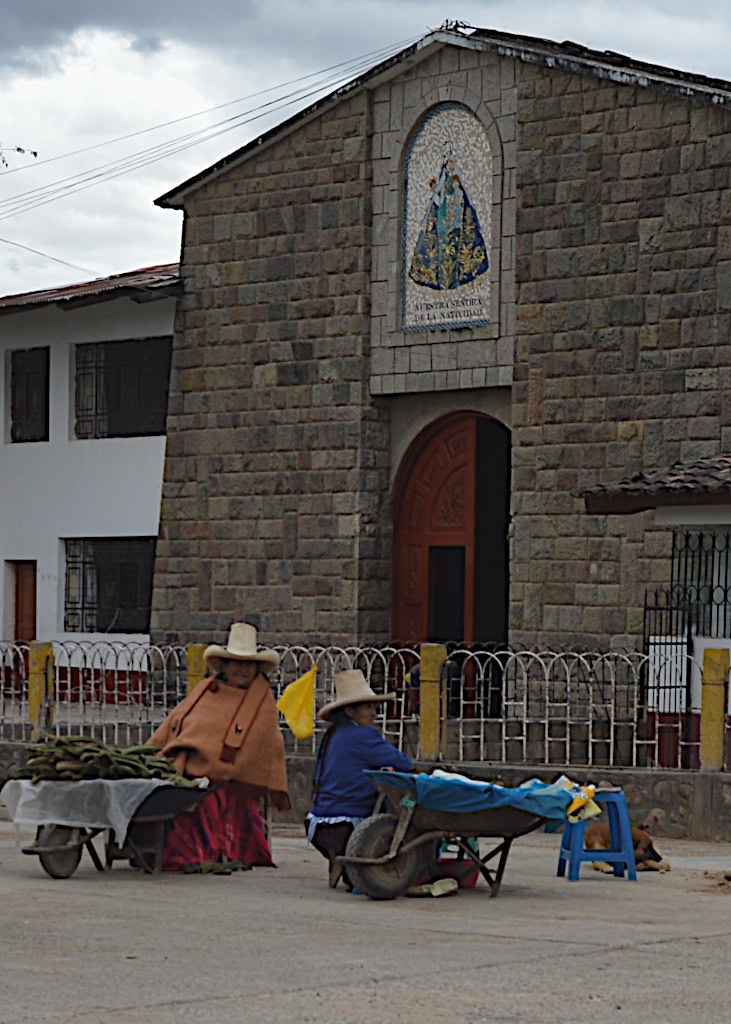
I am reminded that in 2014 Peru is still a developing country where the farm ladies in the market wear traditional garb and yet chat on cell phones and where someone might need to sell a cow to buy a computer.

Vendors

Vendors


Happy Birthday, Dear Shannon!

 Happy Birthday, Shannon! This (true) story is for you.

THE SHARK

Opening Statements

“Hi Shannon, guess where I was this weekend?” I am on the phone with my 6-year-old niece.

“At the cottage?” She loves our cottage.

“Yep. I had a party. A bunch of my girl friends were there.”

“Did you catch any fish?”

Crap. I forgot about her fishing fascination. Think, Kerry, think. You are a lawyer. Answer truthfully and move on.

“Nope. But we swam and played games and-“


Cross Examination

“Weren’t they biting?” Shannon sounds skeptical.

Double crap. Think, think. Your job is to spin answers to tough questions.

“Nope, they weren’t biting.” Technically true: we weren’t giving them anything to bite.


In for the Kill

“Well, did you even try?” Her indignation is palpable.

The witness caves.

“No, we didn’t. We didn’t fish.”

Schooled, Counselor.