Hiking to Machu Picchu Part II – The Trek Begins

5:20 am on Monday morning and Matt, Carl, Mark and I are cramming a few bites of breakfast into our mouths when Edwin and Jimmy, our guides for the trek, arrive at our hotel to pick us up. This is it – no turning back. We grab our backpacks and duffel bags provided to us by Peru Treks and get on the bus. I’m a bit nervous as the duffel bag weighs a precious pound – does that mean I only got to pack 4.5 pounds and not 5.5 pounds? I asked at the trek office on Saturday but didn’t get a clear response, so now I am anxious that I will be forced to leave some of my clothes on the trailhead or, more likely, get Matt to carry them.

As we wind through Cusco, we stop to pick up our fellow trekkers. Each time I size them up: do they look older, fitter, fun? In the end, we have a great group, even if the 4 of us are the oldest on the hike and 20+ years older than many of the others. The only two other Americans on the hike, Dusty and Jenny, are from WI and UW grads, so there is an instant bond with them. The fact that Dusty is a doctor gives me a sense of security and even though he jokes that he can prescribe drugs and refer to specialists, I am confident that he could perform CPR or splint a broken leg in a pinch! Happily, we never have to call on his skills. There are 5 Australians: Erin and Mark, a couple in their 30s; Katie and Tim, friends who have just finished University and are traveling for a few months; and Ian, who has been traveling for 2 years and celebrates his 25th birthday on the trail. Two other youngsters are Kirk from New Zealand and Crazy Henry from Manchester, England. Crazy Henry is so named because he smokes and drinks like a fiend yet can effortlessly scamper up mountains. I am convinced he could have hiked the entire trail in a day with no problem. Diego, who is probably about my age, is from Colombia but lives in the US and speaks perfect English, and is the nicest uncle as he brought his teenage niece, Isabella, on the hike. Isabella also speaks great English and is a sweetheart. After a stop at a designated shop/restaurant in Ollantaytambo, we reach Km 82 and chaos ensues. Our duffel bags are dumped out for us to jam our sleeping bags and mats into them and then have them weighed, we are mobbed by local folks trying to sell us all kinds of things, the sun is hot…overwhelming. After years of the trail being a free-for-all, the government now limits the number of trekkers to 500 starting per day. This number includes all of the porters and guides, so about 200-220 tourists can start the trail each day. We are not trekking during peak season, and I later estimate that about 110 other tourists began the trek with us, but it seems like at least half of them are dropped off at Km 82 at the same time we are. Good news – my duffel bag makes the weigh in, so I am good to go.

The Gang

The Gang

Day 1 is known as the easy day of hike and while it isn’t terribly hard, it is still hiking in the Andes with plenty of ups and downs.We begin hiking at about 10:45. The views are great and we pass some Incan ruins, which we are instructed to call remains as they were not destroyed by man but rather left to the elements. It is cloudy at times, but it never rains. We walk loosely as a group and stop frequently, which actually makes it harder because I never get into a rhythm and the frequent, long breaks make me stiffen up each time. But I understand that the guides are seeing how we do with the altitude and also assessing our hiking abilities for the coming days. We pass farms and houses; it is much like the hikes Matt and I do in the countryside around Cajamarca. At the rest stops there are ladies selling snacks, beverages and coca leaves. Coca leaves are common in Peru and trekkers are advised to chew them to combat altitude sickness and get an energy boost while hiking. I think they taste terrible, and the alkaline substance (made of ash or lye) you add to activate the chemicals in the leaves is awful, but I do chew them during some of the more challenging parts of the hike. I don’t know whether they actually help or have a placebo effect, but the guides and porters swear by them. Having frequent bottled water available is great as I can carry 1 – 1 1/2 liters at a time instead of filling up my camelback to 2 1/2 liters. We stop for lunch at a site with many of the other groups and the porters set up a tent, have buckets of water for us to wash our hands and camp chairs for us to sit on. Our lunch starts with a hot soup (a staple for all lunches and dinners) and is followed by a lot of starches, vegetables and some fried fish. Very civilized.

After lunch, we walk for about an hour and have another break and then finally we make the final push to our camp at 10,137 feet. We climb up past several farms until we reach our barnyard site. I arrive in the middle of the pack at around 4:30. We sleep on animal dung that night, which at the time it seems unpleasant, but when we sleep on rock the second night, the poop site seems nice by comparison! We relax at camp, have dinner and then turn in around 8:00; sunset is around 5:30, so it is already pitch black. Matt and I both sleep well – the only night on the hike that we do. Due to our group’s hiking skills (in fact, the porter with my and Matt’s bags arrives a good 30-40 minutes after I do) we get an extra half hour to sleep in on Tuesday – our wake up call is at 5:30 when the porters shake our tents and bring us coca tea. It is a cloudy morning and we have the dreaded challenging day ahead of us. By 6:30 we are packed up and on the trail.

Day 2 is different than Day 1 – we are allowed to walk at our own pace with a few meeting points along the way, including a morning snack before the big push to the summit. For the first time, I learn the proper way to hike mountains – go slowly and try to keep your breathing and heart rate stable as opposed to climbing in a burst of energy and then resting to recover. This makes perfect sense, and Carl, who has climbed Mt. Kilimanjaro, climbed in this manner the prior day. We are also cautioned to give way to the porters and always keep to the mountain side to avoid being whacked by the porter’s pack and pushed off the mountainside. The porters are amazing – I’m not sure any are taller than I am (5’3″) and they carry huge loads, as Mark can attest. We step aside often for the porters and then try to watch to see how they manage with broken down tennis shoes or sandals. Humbling, to say the least. I also try to see where they walk as they often pick out the best part on the trail – the lowest steps, less slippery spots etc. Each trek company outfits their porters in a specific color; ours wear yellow.

Next Up: The Summit and the Longest Day

If you missed my prior post Hiking to Machu Picchu Part I – Preparation, read it here https://kerryedwyer.com/2014/10/15/hiking-to-machu-picchu-part-i-preparation/

Watertown Senior High School’s Survival Hike: Training for the Inca Trail

As is clear from my prior posts, Matt and I take full advantage of our life in the mountains and hike most weekends. But the truth is that I like walking far more than I like climbing up and down mountains. That said, when Matt, our friend Carl and Carl’s brother Mark decided they were tackling the 4-day Inca Trail hike to Machu Picchu, I decided that I would regret not hiking more than I may end up regretting hiking the trail. We shall see if that proves to be true come early October.

The last time I did an overnight hiking/camping trip was in 1984. Yes, 30 YEARS ago. Watertown (WI) Senior High School had this bizarre right of passage reserved for a select group of decent students: Survival Hike. Led by biology teachers Carlos Alvarez and Dan Herbst (I think another teacher, Tim Gifford was also along for the ride my year), Survival Hike occurred the summer after sophomore year and involved 5 days of trekking up to 20 miles per day in Northern Wisconsin with the “treat” of white water canoeing on the 6th day. The catch, apart from the fact that we carried our own gear, bushwhacked trails, were eaten alive by mosquitos and camped every night: no food. Actually, in the early years food was allowed. First, groups were given $20 to buy provisions for the week. By the time my sister, Mick, went on the hike, provisions totaling a few hundred calories were provided and included a dog biscuit and chocolate. Six years later, we were given nothing – we only ate what we foraged or caught. A few years later, the hike was discontinued.

To this day, I have no idea why our parents allowed Mick or me to participate in Survival Hike. We were not an outdoorsy family and never camped. My mom considered it part of her martyrdom that our vacations were at a cottage with an outhouse. I was not athletic and didn’t own any gear; my mom borrowed a pair of hiking boots that were a size too big for me from a friend’s daughter and I have no idea where my pack came from. Apart from some city walking (we had actually moved to Wauwatosa during my sophomore year but I was given a special exemption to go on the hike, probably because my dad played baseball with Mr. Herbst), I didn’t train at all and never carried a pack.

But I survived. Oh, I whined and probably cried, and threw up when the only thing we found to eat for the entire trip were unripe apples and raspberries (to this day I despise raspberries) on the first day, got about 50 mosquito bites and several blisters, hiked in the rain (I hate wet grass), and lost 15 pounds in 6 days, but I did it. I still don’t exactly understand why I did it, but I have some great memories from the trek: like when two of the guys had to share my friend Katie and my tent because they lost their tent poles and then one of the guys slept walked during a thunderstorm and knocked our tent down. You can imagine the ensuing teenage-girl hysteria. Or when some other kids were getting sent home due to health issues and Mr. Alvarez gave me the option to leave (I really was whining that much) and I made the decision to stay. I like to think that I stopped whining quite so much after that point, but that may be wishful thinking. Or the fact that a guy from Mick’s year, who cried and blamed her when their canoe tipped in the rapids, came along on my year (I think he was doing a bit for NPR) and acted all cool, college-guy when I knew the truth – he just wanted redemption. Plus, it was in the days where your parents signed some waiver and then you got to do totally dangerous, unhealthy things AT YOUR OWN RISK and they didn’t check up on you during the week. And it was long before cell phones so you were in the moment doing what you were doing (hiking! starving!) and not taking pictures and posting every two minutes or calling your parents (or your sister to tell her that cry-baby guy was on your trip although that would have been fun). In fact, I don’t have a single picture from the trip although I am sure someone took a few that I would love/cringe to see.

So with that questionable history, I am signed up for the 4-day Inca Trail hike to Machu Picchu. Compared to Survival Hike, it should be a piece of cake: no bushwhacking, porters to carry the heavy gear, good meals made by the camp cook, decent hiking boots, 26.5 miles over the course of 4 days and no white-water canoeing. But the reality is that the altitude is a killer for many people, the hike is very steep both in ascents and descents, and I am 30 years older. This time, though, I am training and Matt and I have stepped up our weekend hikes to add more altitude. I am even carrying my daypack despite the fact that Matt is usually my porter on our hikes. So maybe my whining will be kept to a minimum on this hike although be warned Matt, Carl and Mark – I am not promising anything.

One Year Ex-Pat Anniversary

One year ago today Matt and I and 17 suitcases/boxes arrived in Peru for our new life of international living.


While our new life has had its challenges, what has surprised us is how easy it has been to make the adjustment. We have both improved our Spanish and can navigate the basics in Peru with relative ease (sometimes even on the phone!), we have grown accustomed to livestock in the road and stray dogs everywhere, our opinion of acceptable cleanliness has been necessarily modified, and we have learned to live without some of our favorite foods and luxuries. While we miss our family and friends, with the internet and wifi phone it has been so easy to keep in touch that almost seems as though we aren’t missing out on anything. A far cry from when I lived in Italy 25 years ago and my only method of communication with anyone stateside apart from my parents (whom I was allowed to call for about 10 minutes every 2-3 weeks) was writing letters.

It has been wonderful to immerse ourselves in local culture by hiking in the mountains near our house, traveling within Peru, enjoying the food (with the possible exception of cuy) and celebrating local customs and traditions. We have made good friends – both Peruvians and other expats. Spending almost a month in Buenos Aries and taking a wine trip to Chile and Argentina were both spectacular. In short, we have made the most of this past year.

So Cheers! to our 1st Anniversary of our new ex-pat life. We wish for many more great international years to come.

World Travelers

World Travelers

Kuelap – The City in the Clouds

The closed eyes, earbuds and raft-envisioning (https://kerryedwyer.com/2014/07/01/roadtripping) aren’t working. We are about 2 hours into the ride to Kuelap from Gocta Falls, a ride that we thought would last only two hours, and Kuelap is nowhere in sight. Well, actually it is, but we aren’t looking in the right place as we don’t know yet that we will wind up, down and around the same canyon for an hour and half before we get there.

I seriously consider whether I want to get out of the van and wait for them to come back for me. But then I realize that I will be left on the road that is causing my panic and will likely get run off a cliff by a passing truck. When we arrived at the Gocta Lodge the prior night, I thought the worst roads of the trip were behind us, until we returned to Cajamarca that is, and the first hour and a half of the drive to Kuelap retraced a less-terrifying part of the prior day’s trip. Then we hit the turn off for Kuelap and started down the narrow dirt road that is considered one of the most dangerous in Peru.

Lest you think I am exaggerating, here is video proof.

About 45 minutes into the dirt-road portion of our drive, we stop in the tiny hamlet of Choctamal for some liquid courage. I am not the only traveler fearing the roads, just the most vocal. The proprietresses could not be nicer and the 3 year old is a sweetie. The ladies laugh at me when I confide that I am petrified of the road and reassure me the road is fine. But we are all disappointed when they tell us we have 45 minutes to go.

I am more relaxed after a few shots from a $2 bottle of rum. And then we hit a rock road block. Just a pile of medium sized rocks in a line across the road right before a curve. Fearing thieves, a few of the guys get out of the van to remove the rocks while the rest of us keep watch. We round the curve and confront a large mound of rocks blocking the road. Now more concerned, the men get out and Miguel asks two passing kids what is going on. The kids say it is a prank by some other kids and help remove the rocks. We give them some coins for their efforts as we had passed them on the road and don’t think they did it. We pass a few more small towns and the reward is in sight: Kuelap.

Kuelap is amazing – it is exactly the place I would have loved to play in as a child. Within the terraced site are 420 circular, 1 square and 4 rectangular buildings. Houses, trees, paths, the view, the mystery…for me, a big part Kuelap’s charm is its unanswerable questions. Why was it built? While originally considered a fortress, due to its mountaintop location, walled perimeter (60 feet high in parts) and three, narrow entrances, it is now generally considered to be a residential complex, but no one knows why the walls exist. How did they make it? Getting those huge rocks to the top of a mountain was no easy feat. Who made it and when? It is believed to be constructed in several phases, beginning in the 6th century and ending several hundred years later, by the Chachapoyas, the Cloud People, but no one is really sure from where the Chachapoyas originated. Instead of pondering these questions too much, we just wander about and enjoy the experience.

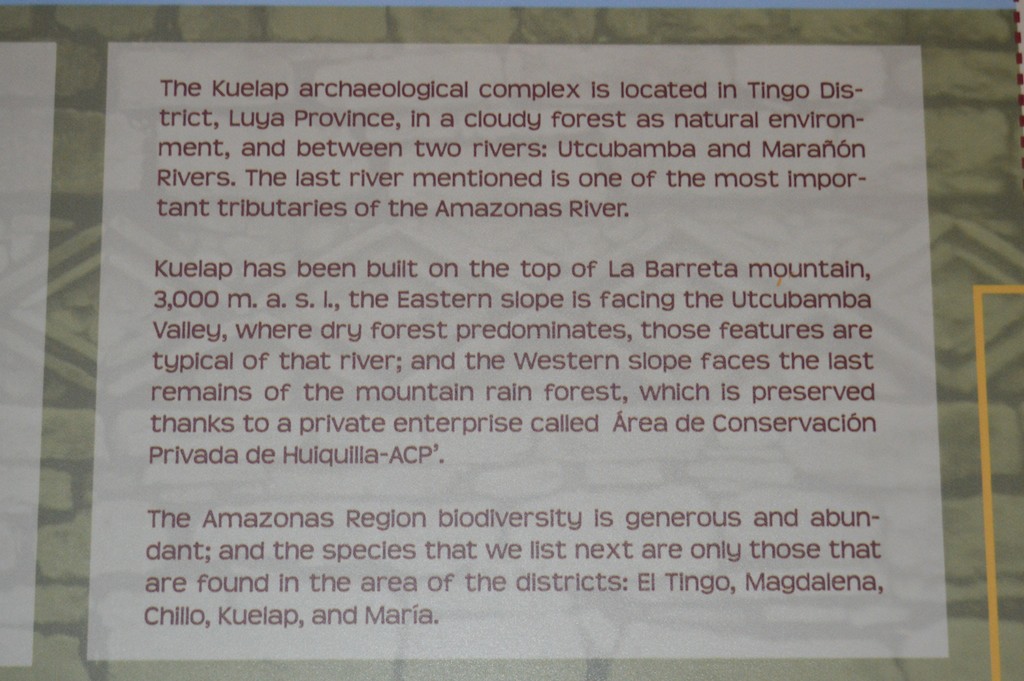
If you want to learn more about where Kuelap is situated, read this description from the visitor center. Or just skip to the pictures.

Kuelap summary

Kuelap summary


This slideshow requires JavaScript.

The ride back seems less terrifying, but as I want to be off the dirt road before dark, we don’t stop to visit our friends in Choctamal although they wave to us as we pass. We also encounter two more rock road blocks and as we arrive at the second one, two young guys on a motorcycle ride up behind us. They converse the entire time our party removes the rocks and we are not sure whether they intended to rob us and decide we outnumber them or the fact that we didn’t leave our van unattended and two of us are staring at them while the others move the rocks deters them. Regardless of whether they were the culprits, the experience increases our desire to get back to the Lodge to relax. We enjoy a nice dinner and then sit outside and star gaze. I see 5 shooting stars and, of course, use all my wishes for a safe journey back to Cajamarca!

Next: The Fantastic Hike to Gocta Falls

Roadtripping

My eyes are screwed shut, my earbuds are playing happy tunes and I am trying to pretend that the jolting motion of the van is the cottage raft swaying gently on the waves. Welcome to a Peruvian Road trip.

Loading the Van

Loading the Van

We are trying to make the most of our time in Peru and decided to take advantage of the 4-day Corpus Christi holiday with a trip to Kuelap and Gocta Falls. Kuelap is an ancient stone complex, the largest in South America, that pre-dates Machu Picchu and is perched 3,000 meters above sea level on ridge overlooking the Utcubamba Valley. Peru is attempting to make Kuelap the next Machu Picchu of tourist destinations and as we live relatively close to it, we decided it was worth the trip. Near Kuelap is Gocta Falls, which by some accounts is the 3rd highest waterfall in the world (apparently there is some controversy over how to measure the heights of waterfalls). So together with fellow Americans Mistina, Teresa, Kevin and Kristen, our Spanish friend Miguel and our Peruvian driver Adderly, we set off early on Thursday morning for the anticipated 10 hour drive through the Andes Mountains.

Those of you who know me know that I DESPISE car rides. I barely tolerate the 5-hour drive to Northern Wisconsin from Milwaukee and have sent Matt off with his friend Pete on road trip adventures. Peruvian roads are notoriously dangerous and before we arrived here, every week Matt would read some story of a bus or van plummeting off a cliff. It quickly became evident why.

The first hour of the trip was pretty good, the views were gorgeous and I was beginning to be lulled into thinking my life wasn’t in danger. Then we hit road construction and were told we had to return to Cajamarca and take the long way, which would add 4 hours onto our trip. Miguel sprung into action, collected our ID cards and somehow managed to convince the road crew to let us through because we were American tourists. Shockingly, we didn’t even have to grease any palms to make that happen. But we did get stuck behind machinery and had a very slow drive to Celendín.

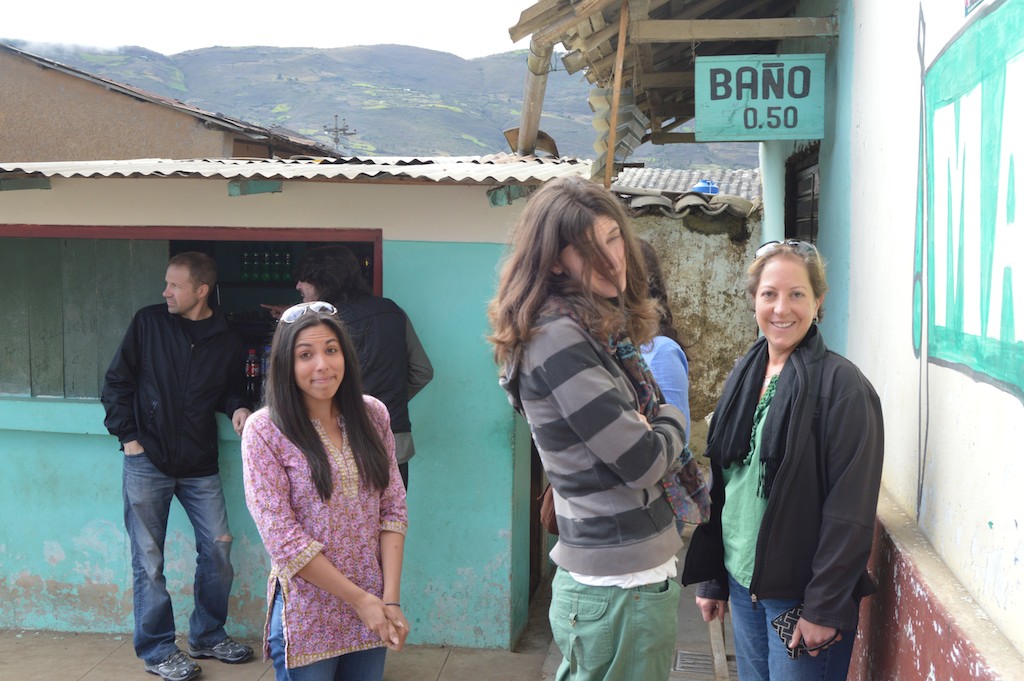
Three hours into our trip, we took a short, necessary break.

Potty Break

Potty Break

After Celendín the roads narrowed and lost all pretense of handling two-way traffic. Thankfully Adderly is young and has his whole life ahead of him so he was a very cautious driver. It also helped that he had excellent reflexes and apparently a strong thumb as he had to toot the horn on every curve to make sure we didn’t get run off the road.

In addition to the traffic there were also animal impediments.

The roads got worse and worse and every time I opened my eyes it appeared we were plummeting off a cliff. We finally took a late lunch break in Leymebamba. It apparently has a wonderful museum, but we still had 3 hours to go until we arrived at Gocta Lodge so we had to pass on the museum.

The roads between Leymebamba and Gocta Falls were actually not terrible and toward the end we were on a decent one along the river. And by decent I mean that it was paved, slightly wider and had signs warning us of falling rocks.

Twelve hours after leaving our house, we arrived at Gocta Lodge in the dark (sunset in Peru is around 6:30) and after settling in we broke open the wine and snacks for a well-deserved happy hour. The next morning, we awoke to these beautiful views.

Little did we know that our relaxation would be short lived as we had the most harrowing drive of all ahead of us!

Next up: Kuelap.

Buenos Aires: Evita, the Beatles, Opera and More

Buenos Aires has so many great museums and other sights that while we saw a lot, we barely scratched the surface (a good reason to return someday).  Here are some of our favorite paid attractions.

1.  Museum of Latin American Art of Buenos Aires (MALBA)  An excellent modern art museum with many different types of exhibits, the MALBA is a beautiful space and organized well.  A definite must-see.

2.  Evita Museum  We had lunch in the museum cafe (amazing warm bread!) and then toured the museum.  The museum looks rather small and we expected to tour it fairly quickly, but it was very interesting with artifacts of various stages of Eva Perón’s short life, she was only 33 when she died, so we spent more time there than anticipated.  My favorite artifacts were her clothes and shoes (I was surprised by  her large shoe size!), but it was interesting to learn about her causes such as women’s rights and children’s welfare.

Evita

Evita (museum cafe)

3.  Japanese Gardens  We actually went to the gardens with the primary purpose of having lunch at the restaurant on the grounds, but the restaurant was closed for the holidays.  The gardens were lovely, but incredibly crowded.  Matt thought this added to the authenticity of the experience as when we visited various gardens in Japan they were usually too crowded to enjoy the tranquility they were intended to inspire!

4.  Teatro Colon  One of my favorite sights in Buenos Aires, I would love to see an opera here some day (while Matt liked the theater, he was happy it was not opera season).  As our tour guide explained, the cost of Teatro Colon cannot be estimated as a building with these specific materials – the particular marble, windows, fixtures- can not be built today. The beauty of the theater is incredible and the English speaking Argentine guide was funny, entertaining and knowledgable as he kept our group moving at the prescribed pace. A few interesting tidbits: the Argentine opera audience is not shy and will hiss at singers who it doesn’t think meet the grade; there are separate entrances depending on ticket price and the materials and styles of the entrances reflect said prices;  and the lower, grated areas under the side boxes were the widows’ boxes where widows who wanted to see the opera but also were in mourning would have to sit to see the opera but not be seen.

5.  Fuerza Bruta  Our entertainment wasn’t all high brow – Fuerza Bruta is a stripped down Cirque de Soleil. The audience stands throughout the show and is constantly moved to accommodate the staging. A mixture of song, dance, performance art, swimming, acrobatics and more, it was an exhilarating hour and a half for the bargain price of $14 a ticket. We didn’t even mind being jostled and having water sprayed on us, it was so fun! See Matt’s blog for some videos of the spectacle.  http://mattgeiger.blogspot.com/2014/02/fuerza-bruta.html

6.  Zoo  While the Buenos Aires Zoo is a bit shabby, it was quite charming with its old buildings and pleasant grounds.  We loved that these guys were freely wandering about and learned that the jackelope is really a Patagonian Mara (relative of the guinea pig, but apparently not eaten in Argentina).

This is a great zoo for kids as patrons are encouraged to buy the special pellets in order to feed most of the animals.  So like the old days at Milwaukee County Zoo, you can see elephants and bears shamelessly begging for food. The enclosures also allow the patrons to get fairly close so you can get a good look at the animals.  Yes, zoos have their negatives and it is always a hard to see the animals captive (well, except for the huge, Amazonian snakes.  I was happy they were captive and still almost threw up looking at them), but if you can put that moral issue aside, it is a nice place to spend a few hours.

7. Xul Solar Museum We really know nothing about Argentine art but Matt read about this museum and thought it sounded neat.  I thought it was cool that the artist changed his name from Oscar Agustín Alejandro Schulz Solari to Xul Solar (note that Xul is Lux backwards, so his name means Solar Light).  In addition to being an artist and sculptor, Xul was a cosmic dude, interested in astrology and reincarnation.  He invented two languages, tarot decks, a mystic game of chess (apparently the board was larger and the rules could change as the game was played) and created a new piano with 3 rows and colored keys.  The museum is small, but interesting.  Because the museum was set up by Xul’s widow and followed Xul’s design, Matt questioned just how famous Xul was if he established his own museum.  But then we saw his works at other museums and some pieces are traveling around the US as part of a joint exhibit of Xul and Jorge Luis Borges’ (writer) works.

8.  Buenos Aires Museum of Modern Art  (MAMBA) This museum doesn’t really deserve to be on the list as we didn’t care for it much; the collection was limited and not well organized.  To be fair, two of the exhibit floors were under construction so it may be more impressive when those are accessible.  And while it normally charges a fee, we happen to go on a free day so it wasn’t all bad. 

9.  Fortabat Museum  We were a bit disappointed when we began our visit as you are first directed to the family gallery and with the exception of the Andy Warhol painting of Mrs. Fortabat, we weren’t too interested.  (Aside: if you own your own gallery, you can put your niece’s substandard work in it too!).  But once we got to the lower level, the quality improved immensely and the artwork was amazing.  My favorites included a fantastic painting of Venice’s Bridge of Sighs, a View from the Empire State Building and a Tower of Babel.  The top level has functional art: bikes, chairs, coat racks etc., which while not of great interest to me, added to the uniqueness of the collection.

10.  The Beatles Museum While the Fab 4 never made it to Buenos Aires to the best of my knowledge, the Cavern Club complex pays tribute to them in style. Created by a Argentine whose Beatles memorabilia  earned him a Guinness World Record for having the largest Beatles collection, the small museum is packed with items ranging from albums to figurines to bubble gum to condoms (John and Yoko label, not the Beatles).  The collector doesn’t appear to play favorites and the solo work by each of the Beatles also gets a nod.

11.  Proa  This museum located in a really cool building in Caminito does not have a permanent collection.  We were fortunate enough to see a fascinating Ron Mueck exhibit that was life-like sculptures of people apart from the scale (they were either big or little, but never exactly right).  The exhibit also had a film that showed him and his staff creating the work.

Proa

Proa

Wow, when I see all that we did on vacation, it is no wonder we were happy to get home to Cajamarca!

Fun Freebies in Buenos Aires

I have been procrastinating posting more about Buenos Aires because we did so much that I am having a hard time organizing all of it into coherent posts. So enjoy today’s post on the fun freebies and stay tuned for posts on the paid attractions, Tango and Salsa and a surprise bonus (yes, I know what it will be).

In no particular order, here are the worthwhile free attractions we enjoyed in Buenos Aires.

Recoleta Cemetery  – No verdant spaces here, this place is a concrete and marble mini-town chock full of mausoleums, statutes and dead people. Some mausoleums are beautifully maintained while others have fallen into creepy, decrepitness. While free, people at the entry will stop you, draw you a map to the main attractions and then hit you up for a “donation” to some cause. Eva Perón is buried here (we learned that it was after much wrangling and moving of her corpse, including overseas, that she was finally interred in her family’s crypt) as are many other Argentine notables. While other famous tombs are marked, Evita’s is not, so the 20 cents I spent on the map was worth it. Had we not toured the cemetery on a day with a heat index of 116 F, we likely could have stayed longer, but we were afraid we would join the corpses.

This slideshow requires JavaScript.

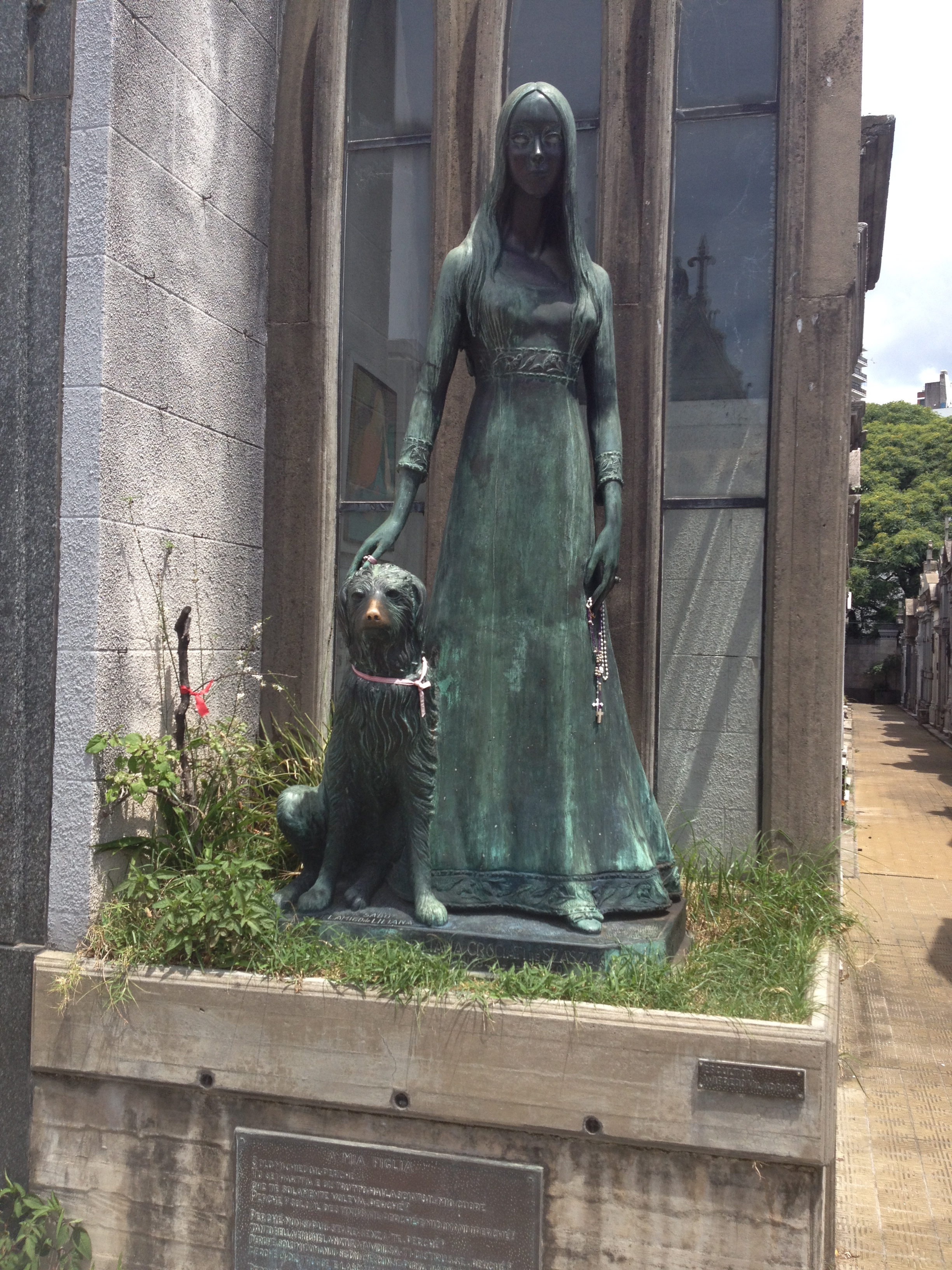
The tomb below is often visited. The young woman died in an earthquake in Innsbruck in 1970 and her parents commissioned a statue of her in her wedding dress to stand outside her tomb. The poem under the statue was written by her father and beseeches God as to why his daughter died. The bronze dog was added after the dog’s death. No mention of the husband, so I’m not sure whether he perished in the earthquake as well.

IMG_1180

Liliana Crociati de Szaszak

Botanical Garden in Palermo  A horticulturist’s dream, this shady retreat is home to over 5,500 plants and trees and a nice place to enjoy a peaceful walk or rest on a park bench. Not that we rested; it’s not our nature to actually sit in one spot while on vacation. I kept saying I was going to go back there some day with a book, but it never happened.

Rose Garden  If you have to pick between the Rose Garden and the Botanical Garden, go for the flowers. The gardens were absolutely beautiful, laid out alongside a lagoon. We must have been there at the right time of year as the flowers were in bloom. There are fountains, statutes, and a pergola covered walkway, which make the whole park lovely. There isn’t a lot of shade, so we saved it for a day that was merely in the high 80s.

Eduardo Sívori Plastic Art Museum  We had no idea why this museum has “Plastic” in its name, so we didn’t have any expectations when we entered. We still don’t know why, as the museum is dedicated to showcasing Argentine art. Wow. The galleries were filled with light and laid out really well and the contemporary art exhibits by Sergio Moscona, César Fioravanti, and Marcelo Mayorga were each distinctive and all very good.

Casa Rosada  This Argentine equivalent to the White House is both the executive office and mansion of the Argentine president (although she lives elsewhere).  We went on the tour, which was a bit dry and didn’t provide a lot of opportunities to take good photos.  One notable aspect of the tour was when the guide, upon showing us the famous balcony where the Peróns spoke to the masses, reminded the group that Madonna (in the movie Evita), and not Eva Perón, sang Don’t Cry for Me Argentina from the balcony. We were also shocked to enter President Cristina Fernández’s office and see her family pictures, desk etc.  Of course, on that date the President hadn’t made an appearance for over a month, so her office hadn’t been used recently!  The Hall of Argentine Bicentennial Women was impressive and filled with portraits of famous Argentine women.  President Fernandez gives her televised speeches from this room, so we later saw it on the news reports when she finally showed up to rule her country.

On the day she was set to make her first appearance after her absence, we happened to walk by the Casa Rosada about two hours before the speech. There were loads of cameramen and many organized groups of people (unions and other issue groups). We waited for about an hour and then decided to go home.  As we watched the news that night, we realized that at some point the gates were opened and all those people and groups were allowed to enter the Casa Rosada’s atrium. After the press conference, Cristina address the crowd in the atrium for about 45 minutes. It would have been cool if we had waited, even if most of what she said would have been lost on us.

Puerto Madero  A gentrified former port, Puerto Madero is filled with shops, restaurants, hotels, a few museums, green spaces, bridges, and ships and is a fun place to hang out for an afternoon. Quiz for my Milwaukee followers: name the architect of the “Woman Bridge” pictured below.  Puerto Madero contains an ecological preserve and there is a long walkway that runs along side the preserve (site of our Salsa day, stay tuned). It also is site of the free Humor Museum, which is in a lovely building that retains its former German brewhouse atmosphere.  The displays were somewhat lost on us due to language and cultural differences in humor.

San Telmo  San Telmo is known for its antique market and shops but I managed to buy a nice pair of sandals there instead. On Sundays, the main drag, Calle Defensa, is closed to traffic and becomes a bustling flea market that extends for blocks on end. Flea market doesn’t entirely do it justice as in additional to all of the wares there are musicians, street foods, tango dancers and throngs of people enjoying the scene. Matt bought his first prized mate cup here and we found the popernipperings here too. Plaza Dorrego is nice and if you miss the flea market, there are plenty of vendors hawking their wares there every day of the week.

National Museum of Fine Arts  While it does not rank as my favorite museum in Buenos Aires, a visit to this free museum is worth it. It has a large collection of international art from the Middle Ages to the 20th century, including several rooms devoted to Argentine painters. It’s been about a month, but I remember a room devoted to the Impressionists, Rodin’s Kiss and a creepy bust, a collection of bombillas (silver mate straws), and gorgeous display of hair combs that were so ornate and large I am not sure how one would hold her head up. The museum is raising funds for air conditioning (only one room has it thus far), so as we went on the same day as the Recoleta Cemetery, we were not able to linger long due to the extreme heat. Near the Museum is the ginormous Floralis Generica, which opens at dawn and closes at dusk.

Plazas, Monuments and More Plazas There are countless plazas to enjoy in Buenos Aires: Plaza de Mayo outside the Casa Rosada is a big demonstration site with camps and signs everywhere, Plaza de la República has the iconic obelisk, Plaza San Martin is a huge park, Plaza Italia was near our apartment so we passed it daily, Plaza del Congreso has Rodin’s the Thinker, among other sculptures … The list goes on.  Everywhere you look there is a Plaza and a Monument to enjoy.

Hipódromo Argentino de Palermo  I know I already devoted part of a post to the horse track and casino, but it was so fun we went twice so it is worth mentioning again.  It truly can be a free event if you don’t wager and in addition to enjoying the races, the people watching is great too.

Home stretch!

Home stretch!

Next up: the paid attractions.

Bread, Glorious Bread

Argentine beef has nothing on Argentine bread.*  I am a carb queen and bread tops my list.  That said, about 2 years ago Matt and I started following a low carb diet and bread was banned from our house except when we had company or on a rare special occasion.  Avoiding bread in Peru isn’t too difficult as restaurants do not serve bread (instead serving cancha, carbs, I  know, but irresistible).  And then we got to Argentina.  Bread Bliss.  Flaky rolls, yeasty slices, crispy crackers, warm loafs, crunchy grissini, crackling wheats – we had them all.  These were some of the outstanding ones.

This slideshow requires JavaScript.

Every restaurant had different breads, and while the nicer restaurants generally had the best kinds, sometimes the small joints pleasantly surprised us.  The typical accompaniment was a diluted cream cheese concoction, with chives (most common), herbs or, once, beets.  Butter and olive oil were rare and sadly tasteless.  The olive oil in particular was a surprising disappointment as we expected good olive oil to come with good wine.  No such luck.  My favorite accompaniment was the eggplant spread, which we had at two different places.

Bread and Eggplant

Bread and Eggplant

Now we are back in Peru and off the bread.  Sigh.

*  I actually mean that.  Despite Argentina’s reputation for amazing beef, we were generally underwhelmed.  We had some decent beef, but none so tender you could cut it with a butter knife.  And sometimes you couldn’t cut it with a steak knife.  We did have a darn good burger at Burger Joint – the best we have found in South America, including the ones we cook at home!

IMG_2863

Caminito: the Tourist Trap that Grew on Me

Known for its brightly painted houses, street artists and tango dancers, Caminito is one of Buenos Aires’ touristic “must sees.”  Caminito is located in the Boca neighborhood, which is also home to the Boca Juniors, one of Buenos Aires’ premier soccer teams.  Boca is an impoverished, run down area that wouldn’t see any tourists apart from Caminito and the Boca Juniors.  In fact, tourists are warned to stay within the Caminito area, which includes the Boca Juniors’ stadium, the Bombonera, and to skedaddle before dusk.

Matt and I headed to Caminito one Wednesday and proudly navigated the bus system to get there.  While that may not seem like a big deal, understanding public transportation in a foreign culture and language is always an adventure. Subways are pretty straightforward and once you have been on one the rest are fairly easy to understand.  Buses are different.  When you don’t know how much to pay or how to pay (cash, tickets, passes), it is difficult to try to understand with limited language skills, while a line of people queue up behind you.  For this reason, most tourists stick with cabs, but we were armed with a transportation pass that we were determined to use on more than just the subway.  We learned from our Peruvian friend Jocelyn, who lives in Buenos Aires, that when you get on the bus you tell the driver your final destination and he determines your fare, which you then pay by holding your transportation pass up to the scanner or paying cash. So we set out for Caminito on the bus and managed to get off at the right stop (okay, that part was pretty easy as it was the last stop before the bus turned around), but still, we were feeling pretty proud of ourselves for our bus-taking sense of adventure.

And then our hearts sank: what kind of tourist hell were we in?  Despite my popener quest, I typically am not a shopper.  I shop when I have something I need to buy, not as its own form of entertainment.  And Caminito, as far as the eye could see, was a several block area of street vendors and knick-knack shops, interspersed with tourist restaurants, generally featuring a tango show, guacho show or some other show.  UGH.  It reminded me of the lowest point on our Alaskan cruise, Skagway, Alaska, that was little more than a fake Wild West town geared for tourists. Matt and I assured each other that we didn’t have to stay long and started walking around.  Despite the pushy vendors and tacky souvenirs, the bright colors and art work created a lively ambiance and we began to enjoy the experience for what it was: tacky and hokey, but fun and with some neat street art. We even fully embraced the tacky shopping experience via the popener quest. (If you missed that post, you can find it here:  https://kerryedwyer.com/2014/01/21/the-quest-for-a-popener/)

We intended to visit two museums in Caminito, but the Museum of Decorative Arts of Benito Quinquela Martín (the creator of Caminito) was closed in January, a common occurrence in Buenos Aires, where residents leave for the month to escape the heat.  We went to Fundación Proa and were not disappointed in the Ron Mueck exhibit.  We had never heard of Mueck, a contemporary Australian artist, but his work was unique and great to see.  http://en.wikipedia.org/wiki/Ron_Mueck

We also sucked it up and ate at an outside cafe where we saw tango dancers and then two guys play guitars.  The tango dancers were okay, but the guitarists were really great and we enjoyed the show.  And my inexpensive steak sandwich with chimichurri sauce was one of my best steaks in the city thus far.  All in all, an enjoyable experience although one I do not feel the need to repeat, unless we decide to visit the Museum of Decorative Arts as it is now February and open again.

5 Reasons I Love Buenos Aires

From the moment Matt and I arrived in Buenos Aires, we were smitten.  Ten days later our passion hasn’t faded – despite the heat and dog poop, this place is great and has made the list of places we would like to live some day.  Here are my current top 5 reasons this city is fantastic.

1.  Green.  Buenos Aires does parks right.  There are green spaces everywhere, ranging from the large parks and gardens in Palermo to small squares in every neighborhood.  Old, lofty trees line many streets, adding shade and beauty to an urban environment.  There are also numerous plazas that incorporate green spaces as opposed to being just a fountain or statue on a slab of concrete.

2.  Vibe.  Buenos Aires is laid back with coffee shops and bars galore.  While many guide books talk about the congestion and fast pace, we haven’t felt it, possibly because we arrived during a heat wave that forced life to slow down. People here dress casually – it is the first time I have been to a major city outside of the US and could wear shorts without looking like a tourist.  People linger over lunch and hang out at the bars until the wee hours of the morning.  The fact that Matt and I can both pass as locals (due to Italian genes), until we talk, also makes us feel very comfortable here as we are not immediately spotted as tourists.

3.  Food.  With a strong Italian influence and wonderful beef, the food here is amazing.  Items not to be missed include carne asada (grilled meats) , milanese (thin cutlets of beef, chicken or soy [is there a such thing as a soy cutlet?], breaded and pan fried), alfajores (shortbread cookies with dulce de leche filling, sometimes covered in chocolate), empanadas (savory, filled turnovers), pizza and helado (ice cream).  And bread.  I will be writing an entire post devoted to the bread here; it is that good.  The cuisine is not only local – there are plenty of Japanese, Peruvian, Chinese, Indian and other restaurants to choose from.  We went to an Armenian place in the neighborhood that was delicious.

4.  Wine.  What is great food without great wine?  Malbecs rule the roost, but excellent Cabernet Sauvignons, Syrahs, and red blends abound as do several delicious Argentine white wines.  The proximity of the Mendoza region and an apparent lack of sin tax makes wine as affordable as a soda (or at least that is my excuse for drinking at lunch).

Wine tasting

Wine tasting

5.  The weak peso.  I feel a bit guilty writing that as the Argentines’ misfortune is to our benefit, but for once Matt and I are on the right side of the exchange rate.  Despite this being the second largest city in South America, we have been able to enjoy ourselves without breaking the bank, with wonderful dinners with excellent wines costing around $70, far less than similar meals would cost in Milwaukee.  We have offset those dinners by going to more modest restaurants and eating at home – today we bought two servings of a torta (these were similar in look to a quiche, with a pastry crust but a filling that wasn’t eggs – one was ham and cheese and one a minced chicken filling) and some cookies for dinner for less than $8.  The tortas are huge and we have plenty of cookies, so we will get two meals out of our purchase.

While we enjoy living in Cajamarca, the two experiences couldn’t be more different so we plan to make the most of our last two weeks in Buenos Aires.  Or maybe that is just another excuse for drinking a lot of great, inexpensive wines and eating to my heart’s content!