El Condor Pasa – Cruising the Colca Canyon Part III

Soaring

Soaring

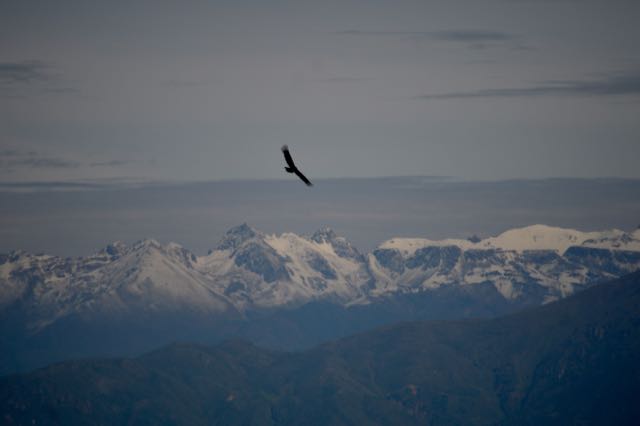
The main reason most people travel to the Colca Canyon is to see the Andean condors soar through the valley and we were no exception. While we enjoyed all of our trip: hikes, homestay, bird watching, hot springs, cave art and more, the main event was watching the condors.

Our guide, Salome, planned the viewing perfectly: we left our hotel at 7:30 to travel to Condor Cross and arrived shortly before 8. Only a few tourists were gathered. The bus tours stay in a town farther away or come from Arequipa, so we were able to sleep in, if you consider getting up at 6:30 am to be sleeping in, and still arrive before the masses.

Salome quickly got us situated in a prime spot she had shown us the previous day and immediately directed our attention downward where 5 condors were gathered (we only spotted 4, but Salome leaned waaay over and saw a fifth). We laughed that none of the other tourists had noticed them and then nicely showed them where the condors were resting.

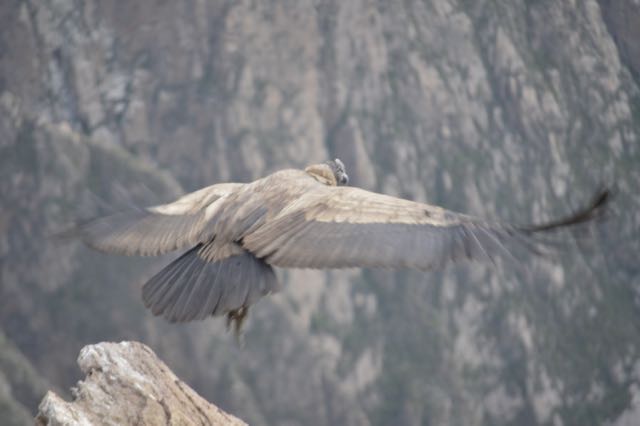
And then we waited. And waited. We were now inundated with other tourists, but held firm to our prized positions. I bushed off some very rusty Italian and chatted with a friendly, Italian-speaking Swiss tourist. A hawk flew by and got us all excited until we realized it was only a hawk. Then one juvenile condor, followed by a second, took off and began soaring through the valley. It was breathtaking to watch them glide and drift through the canyon on the air currents. Eventually, the adult condors got in on the action and other condors also appeared to provide us excellent, live entertainment.
We Have Lift Off!

We Have Lift Off!

What goes up, must come down…

This slideshow requires JavaScript.

After about an hour, we started the short hike to the van. I was delighted with having seen 6 condors at that point, but on our return hike we saw another 8 condors. Every time we stopped watching to walk a bit more, another one or two would appear. We felt incredibly fortunate especially because the Belgians we met at the homestay only saw two condors the day they visited. Lilian later teased us and asked whether we would brag about how many condors we saw if we ran into them in Lake Titicaca. We did not see the Belgians again, so we were not tested.

Our day’s fun was not over. On our way out of the canyon we stopped in Maca to enjoy a colca sour  – a pisco sour made with cactus fruit (sancayo) juice. While I normally skip street food due to a sensitive stomach even after living in Peru, I wasn’t passing up a colca sour! Salome knows the owner, so we also got to see the skull of a family ancestor. They don’t know exactly who the person was but found the skull when tilling the family field. They named it Juan (I think) and treat it respectfully (if charging a small gratuity to see it counts as respect). Note his elongated skull of the Collaguas people.

Maca was set up for tourism, something that gives me mixed feelings. On the one hand, I do not begrudge anyone from making a living, particularly from tasty cocktails, and if we can help drive a local economy, I am happy to do it. On the other hand, there is a fine line between sharing one’s culture and turning it into a tourist trap. Our homestay was a genuine experience, Maca was borderline and Lake Titicaca was the worst of its kind.

After our drink, we visited Santa Ana church. We had visited a handful of mountain churches on our trip, but after the grandeur of the Arequipa churches and monasteries, we were a bit churched-out. Maca’s church had been damaged in an earthquake but still retained much of its spectacular, gold-leafed interior. It also had an impressive display of statues, most with gorgeous embroidered clothing. Salome pointed out the indigenous and Spanish influences in all of these mountain churches. She also told us how the main statues used in processions would get new clothes every year and how families would try to outdo one another with the grandness of the clothing.

Finally, there were these crazy statues in the town square.

Salome tried to ask a local about the action-hero guerrilla on the woman’s back but all the man would say was that the statue wasn’t a correct depiction. When Salome asked what the proper depiction should be or what the folktale was behind the statue, he kept complaining how the statue wasn’t done correctly. Eventually she gave up, but Matt and I felt vindicated. We feel like we have these bizarre conversations often in Spanish and always attribute it to our lack of language skills. But no, sometimes people just spend a lot of effort repeating the same non- answer over and over again!

We left Maca and made our way out of the canyon with one final scenic stop to view the mountains. Then we were on to Puno on the banks of Lake Titicaca where Salome and Lilian left us to make their long drive back to Arequipa to be home in time for the obligatory elections the next day. What a great trip we had with them!

Cruising the Colca Canyon Part I – Cave Art

Las Ventanas del Colca - the Windows to Colca

Las Ventanas del Colca – the Windows to Colca

We were happy to be back in Peru: we had dinner with friends in Lima, revisited Machu Picchu the easy way and not after a 4-day hike, relaxed in Cusco, and enjoyed the great restaurants and colonial streets of Arequipa. Then we hopped into a van with our driver Lilian and our guide Salomé, left Arequipa and headed for the Colca Canyon, hailed as the second-deepest in the world at 3,400 meters (11,155 feet)  and “twice as deep as the Grand Canyon,” for a 3-day adventure.

What a fantastic time! We lucked out with the weather – the rain came as we drove (not lucky for Lilian) or ate lunch. I generally hate car rides, but Salomé was an entertaining and knowledgable guide and Lilian an excellent driver. The roads on this trip were well maintained by Peruvian standards and I had none of the terror our trip to Kuelap had induced. (Roadtripping and Kuelap – The City in the Clouds posts) We enjoyed the views and a few hikes back at high altitude. It was great to be in the Andes, breathing the fresh mountain air and enjoying the vicuña, alpaca and llama sightings as well as the mountain peaks.

Apart from seeing the condors (subject of an upcoming post), my other goal quickly became to finally learn to identify the difference between alpacas and llamas. Confession: for the 2 years I lived in Peru any time I had a camelid picture, I would run it by my cousin Maureen who raises alpacas to get the proper identification (thanks Maureen!). Salomé gave me more specific identification pointers and, after 3 days, I felt fairly confident. Until we learned that some of the confusing ones were likely cross-bred and thus a combo alpaca-llama. So here it goes: llamas have bigger, curvier ears and pointier faces while alpacas have straight ears and less pointy, smaller faces. I had been told that before, but things like “bigger” and “smaller” are relative, so it helps to have both animals to confidently distinguish. Then I got the definitive factor – look at their butts. Llama have tails that poof out and up and alpaca tails are against the body. At last, an easier method!

Salomé - left hand is alpaca, right is llama!

Salomé – left hand is alpaca, right is llama!

Our next destination was to see 8,000 year old cave art in Sumbay. Sumbay is at an altitude of 14,429 feet (4,397 meters), so we first stopped for some coca tea to counter the effects of the high altitude.

We headed off the main road down a a rutted, rocky path, the worst of the entire trip. “Are you sure you don’t want us to walk?” I asked Lilian as I had visions of the van bottoming out and being stuck in the middle of nowhere. She assured us it was fine and navigated the so-called road. Salomé explained that during a mining boom the railroad stopped in Sumbay and the town was thriving, but subsequently better roads were built, the railroad ceased and Sumbay became a ghost town save one lone holdout who literally has the key to the caves. As soon as we pulled into the abandoned town, there was José. We initially weren’t sure whether he was irritated that we were there as he stood with his arms crossed over his chest in a somewhat aggressive pose, but it became quickly apparent that he was anxious for the company and happy to show us around. He told Salomé that he was halfway up the mountain with his grazing animals and when he saw the van on the road, he ran down the mountain so he could be waiting for us. A race we didn’t even know we were having! I found José as interesting as the cave art: why would he stay isolated in Sumbay when his family and village had all moved on? Like most people, José didn’t want to leave the life he knew. He had animals to care for, the cave to protect and he found Arequipa, where his wife and children lived, to be too chaotic and busy. So he lives alone, with occasional visits from his family and one or two tourist visits a week.

After some conversation, we set off on a 20 minute hike into the canyon to see the caves. Along the way we saw this cute viscacha skipping over the rocks.

Viscacha

Viscacha

We arrived at the caves and José unlocked the chain link fence so we could get close to the art. Most of the figures were camelids and it is believed that the pictures depict the domestication of the animals. There are some hunting and domestication scenes as well a couple of pumas and some rheas, which are American relatives of the ostrich and emu.  It was a spectacular sight tucked away in the valley. José was a capable guide and pointed out all of the notable figures to us. After hiking back to the town, we said goodbye to José after tipping him and giving him some of our snacks. We would have bought provisions for him had we known the isolated life he leads.

And that “twice as deep as the Grand Canyon” claim to fame? Well, it’s a bit misleading. The canyon’s depth is measured from the tippy top of its highest peak, not anywhere tourists are going to hang out. In some places, the top of the canyon is pretty close to its bottom. It doesn’t have the wide, open expanse of the Grand Canyon, and the vertical drop-offs aren’t as steep. The canyon is habitable and pre-Incan and Incan cultures created terraces for farming the land. While the Colca Canyon is spectacular, the majesty of the Grand Canyon is still tops in my book.

Farmland in the Valley

Farmland in the Colca Valley

Next Stop: A Home Stay in Sibayo