Tambo Colorado (Vacation Part VII – Final Site)

First, my apologies for the lack of posts in the past few weeks.  We went out of town (stayed tuned for posts on Huanchaco and Truijillo), I painted our bedroom (never again) and we have had more social/school events to attend. Matt and I both have stepped up our Spanish studies, supplementing our weekly lessons with watching Destinos, a cheesy miniseries designed to teach Spanish to Americans, and Duolingo, an on-line language learning program.  I also started taking yoga twice a week, which I love.  The instructor is great, there are only 5 of us in the class (two whom I knew prior to class) and it is another Spanish immersion event for me.  So life continues to go well for us in Peru.

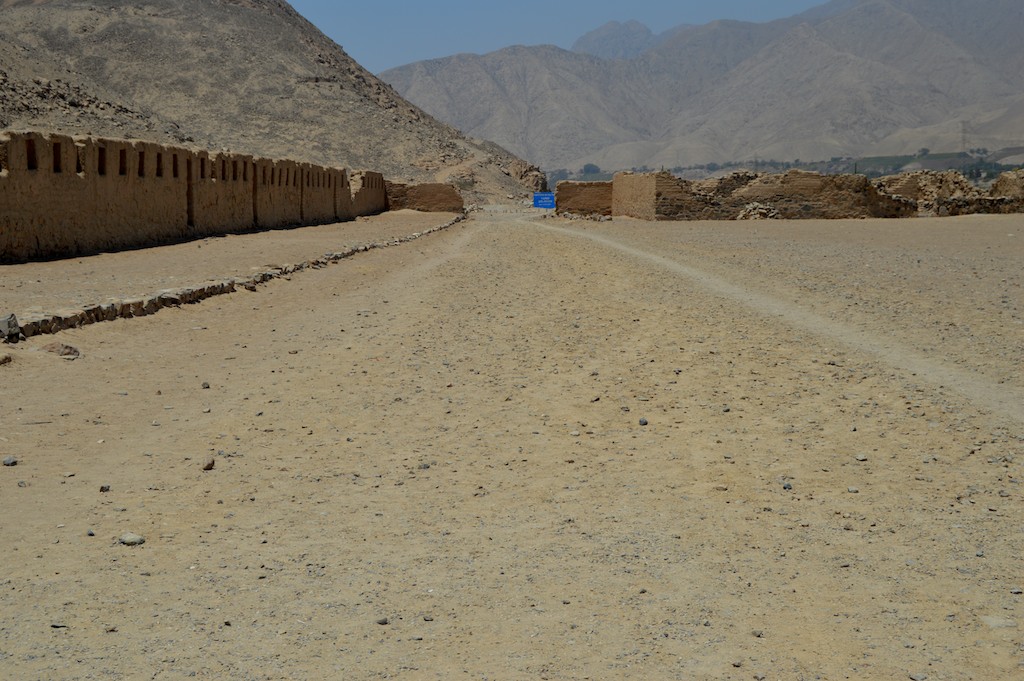
Our last tour in the Paracas area was a trip to Tambo Colorado, which roughly translates as “red place” or “red resting place.” Built in the mid to late 1400s during the reign of the Incan Pachacutec, Tambo Colorado is believed to have been an administrative site used when the Incan ruling class travelled on the Inca Trail from Cuzco, the historic capital of the Incan empire, to other parts of the empire.  It is strategically located on the road that runs between the coast and the mountains and built into the side of a mountain, overlooking the Pisco Valley.  Due to the desert conditions, the site is the best preserved example of adobe construction from the Incan era and is famous for retaining some original red, yellow and white paint on its walls.

The pictures don’t do justice to the site, which quite large and impressive.  If memory serves me, starting from the river, there was a burial ground, then buildings that were believed to house the lower class workers/animals, the large public square, and then living areas that ascend the hill and end with the ruling class’s  quarters at the top.  The architecture has typical Incan features, such as trapezoid wall niches (double niches in the ruler’s quarters), trapezoid doorways, and geometric ornamentation in the ruling class’s quarters.  The layout of the rulers’ quarters was really interesting  and designed with security in mind: rooms with two doorways, so a quick get-away could be made; narrow hallways that allowed only one person to pass; sentry niches at the doorways believed to be the ruler’s bedroom; and two very nice baths, complete with irrigation systems and drains.

Finally, the site had the added bonus of our first view of the Inca trail (in the picture it winds up the hill).  While it is possible that we have seen it before, this was the first time we realized what it was.  The Incans had an amazing road system, with two main North-South arteries, connected by many branches.  The most famous part of the trail is the hike to Machu Picchu, something we intend to do while we live here.
Inca Trail

Inca Trail

Vacation Part I – Pisco

While my life is an endless vacation, Matt had his first vacation last week.  Because we are saving Machu Picchu, the main Peruvian attraction for when we have visitors, we decided to head south to the Ica region of Peru to see the sights and do some wine/pisco tastings.  Easier said than done; given our Cajamarca location, our trip required us to first fly to Lima for the evening and then catch an early flight to Pisco.  Imagine our surprise when we discovered this was our commercial airplane to Pisco:

LC Peru Twin Otter

Neither Matt nor I fear flying, so we didn’t mind the small plane although it was a little disconcerting to realize the co-pilot was being trained.  But there was even complimentary snack service, which is more than most major airlines provide these days.

We landed in Pisco (which is both a place and a liquor) and were picked up by our driver, Guillermo, and our English-speaking guide, Patricia.  While we were originally going to go to our hotel in Huacachina for a few hours and then have our wine/pisco tours in the afternoon, the plan changed and we were at our first winery stop, Vista Allegre, by 9:30 am.  We were hoping to find some good Peruvian wine on this trip, but our tours confirmed our fears: there is no good Peruvian wine.  There is some okay, everyday wine, but nothing amazing.  We also learned that Peruvians are incredibly proud of their pisco and are in a feud with Chile over the right to call their respective liquors pisco.  In early October, the El Salvador Supreme Court ruled that only Peru may use the name pisco.  I am not sure whether that means anything outside of El Salvador (the way only France can market champagne), but the Peruvians were pretty happy and proud to share the news with us.

Our drive was surreal; there was no confusing our location with Napa.  We were in a desert with huge sand dunes, yet Ica is also an agriculture area due to its sunny climate.  Check your asparagus – it may be from Peru.  Other crops include cotton, potatoes, olives and, of course, grapes for wine and pisco.  As a result of the agriculture, transplants from the jungle, where there is no real industry to support people, migrate to the area to work in the fields.  We saw many odd straw hut communities in the middle of nowhere that didn’t appear to be inhabited. We were told they are “planned invasions” – transient communities that come and squat on the land and eventually own it if the government cooperates and no landowner throws them off.   The process is very political and some locals greatly oppose it.   It sounded very odd at first until we thought about Western migration in the US.

We were handed off to the winery’s tour guide, a young guy who spoke decent English and did a nice job explaining the pisco distilling process.  (Although I think Matt was offended when the guide disparaged blended whiskeys.) I assumed pisco was like grappa and was made from distilling the leftovers (stems, seeds, skins) of the wine making process, but it is not.  Fresh grapes are pressed/stomped to make pisco.  If you are interested in learning more about the process, this link will take you to a decent explanation (although we did not go to this winery). http://www.barsolpisco.com/web/index.php/process

After our tasting, we headed to our next stop, Tacama, the oldest winery in Peru.  We were excited to go there as Tacama Gran Tinto is one of the few Peruvian wines we drink and we were hoping to try some of their other reds in an effort to find a better one.  Unfortunately, the Gran Tinto was the best we tasted.  The grounds at Tacama were beautiful and the traditional caballero/señorita dance was a nice touch.

Our final stop was a smaller producer, Bodega El Catador, which is on a compound of several wineries and restaurants owned by different members of a family.  The tour showed the traditional way of making pisco, complete with ceramic casks.  It was very interesting and we made our only purchase of the day: a bottle of fig-infused pisco.  It has a creaminess reminiscent of Baileys and is quite tasty.  Or maybe it just seemed tasty because we were up at 5:00 and wine/pisco tasting by 10:00 am!

Next up: We hit the dunes!