An Out-of-This-World Experience

“We are 20 years too old for this trip,” I protested. “This trip” was a 3-day, 2-night SUV trip through the high plains of Bolivia and ending in the Uyuni salt flat, the world’s largest. The reviews and tour operators were blunt – there is nothing luxurious about the trip. We would be bumping along basic roads, staying in hostels, and paying for cold showers. The basic accommodations weren’t my main issue – I’ve grown more accustomed to roughing it than I ever expected –  road trips are not my thing. No matter how beautiful the scenery, my attention span is short. But Matt was set on going, and our friend Lisa enticed me with some fantastic photos and assurances that the scenery is different at every turn, so I ultimately acquiesced.
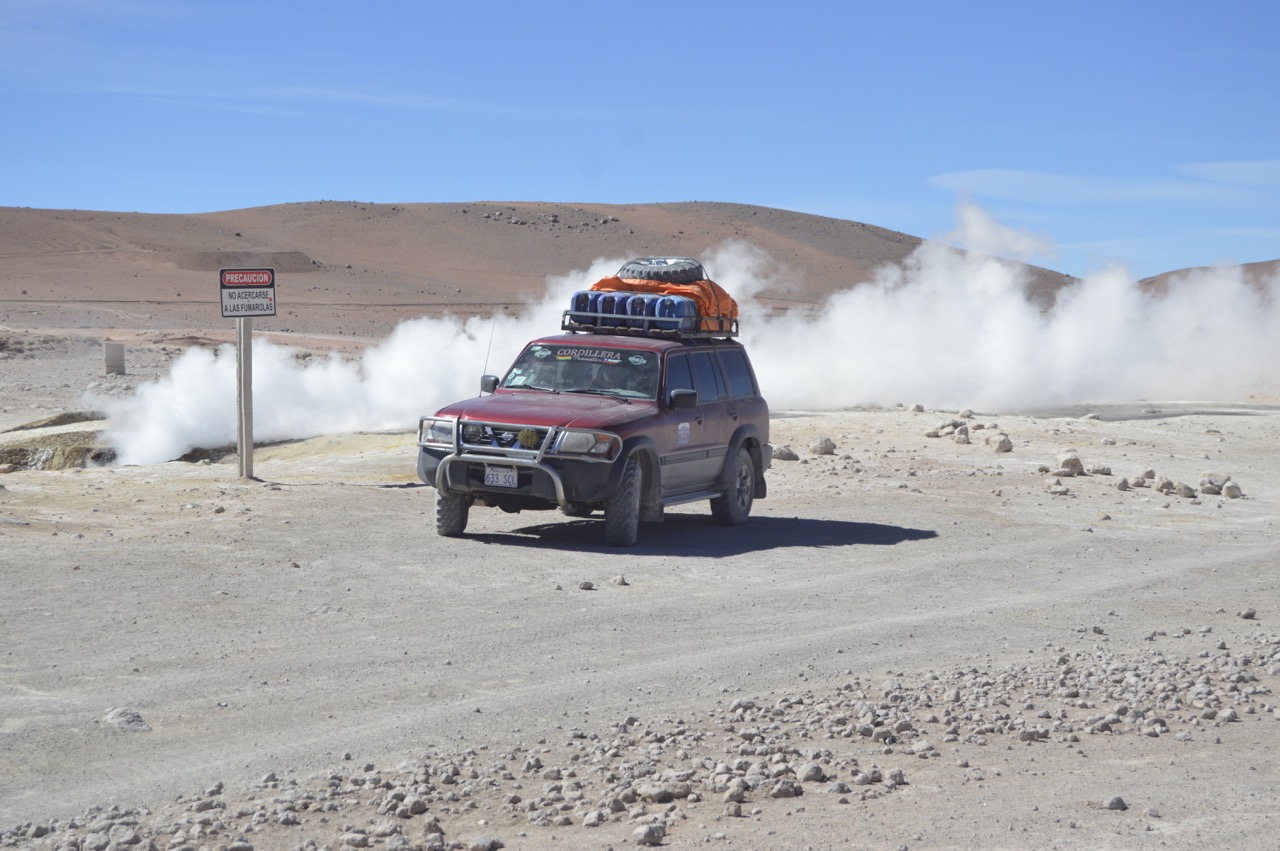
Our ride

We were in San Pedro de Atacama, Chile, and would cross the Chile-Bolivia border at the onset of the trip. We didn’t have Bolivian visas, but the tour operator told us that all we needed were two headshots each, our yellow fever cards and passports in order to get the visas at the border. We had one one photo each, and he assured us that it would likely be fine. We were booked on day tours in San Pedro and when we tried to get new photos in the late afternoon the day before our Uyuni tour, we were out of luck: the store was open, but the woman who took the photos wasn’t working that day. Four years ago we would have freaked out at this news and railed about how inefficient it is to have only one worker who can take a picture anywhere in town, but we just shrugged and hoped for the best.

Sand as Far as the Eye Can See

On the day of the trip, a Chilean driver picked us up in a van early in the morning and drove us about 6 blocks to the Chilean immigration office where we joined the the long line of fellow travelers. After about an hour, and somehow with our group being corralled to be dead last, we had our exit stamps and were free to leave the country.

Door to the Immigration Office – Look Carefully – I Closed Wolski’s!

We set off through the desert to the border. That is, first we hit the Chilean border and then after 10 minutes of no-man’s land, we hit Bolivia.

Bolivian Immigration Office

We headed inside to immigration while our Chilean driver transerred our stuff to the SUV and our Bolivian driver. We were a little nervous about the one-photo issue when we got to the front of the immigration line. There were two men working: a policeman and the immigration official. The policeman took our documents and asked for our color copies. Ummm, what? We had passport copies somewhere in our luggage that was now strapped down on the SUV, but no copies of our yellow fever card. Matt let me do the talking and I played the stupid card – because we were. I apologized profusely, asked what we could do, and explained that no one told us we needed copies. The policeman feigned concern for us, explained they had no copy machine in the building (obviously, I’m not sure there was electricity!), and told us how much they needed the copies. We danced the dance, both knowing that the universal finale was inevitable – cold, hard, American cash. When the policeman pulled out his phone and started taking pictures of our documents, I knew we were in. He told us that he would drive to San Pedro on his lunch break to print off the photos and a small tip would be appreciated for his effort. I knew I had $30 in one pocket but also knew that there was no way to surreptitiously separate the $10 from the $20, so I pulled out the $30 and asked if that would compensate him for his time. No surprise: it would.

He passed us over to the immigration official and explained how he would come with our documents later. I believe this to be true in that everyone else had copies that were attached to the paperwork, but I suspect that no special trip was made and that he simply printed off the documents when he went home for the night. The immigration official was friendly and didn’t raise a fuss. The fee was $320 and I handed him 4 hundreds. He peeled off 3 twenties and handed them to me one-by-one while complimenting my Spanish, showing me the 10-year visas he gave us and urging us to return many times to Bolivia. I knew, and he knew that I knew, that he was ripping me off but after about a 10 second stare down, I smiled, said thanks and we skedaddled with our visa stamps.

We lucked out and had a great group – Beatrice and Jorge from Puerto Rico and Eilidh and Justine from Scotland. While they were all at least 20 years younger than us, we got along well and had good laughs. The fact that Beatrice and Jorge were bilingual was an added bonus as our driver only spoke Spanish and they could translate as needed (although Matt and I understood most of what he told us). We were not traveling in a caravan, but all the SUV tours were going to the same places along the way. We ran into a few groups and they all seemed crabby compared to ours, so we felt fortunate. Although our food was so terrible that a stray dog wouldn’t even eat the cake I offered it. One day I traded my pâté and stale bread for another traveler’s cake. Both parties considered themselves to have received the better end of that bargain.

What a great first day! Who knew that sand came in so many colors?! Or that pink flamingoes live at 15,000 feet above sea level on a red lake in a desert? We were delighted at every turn.
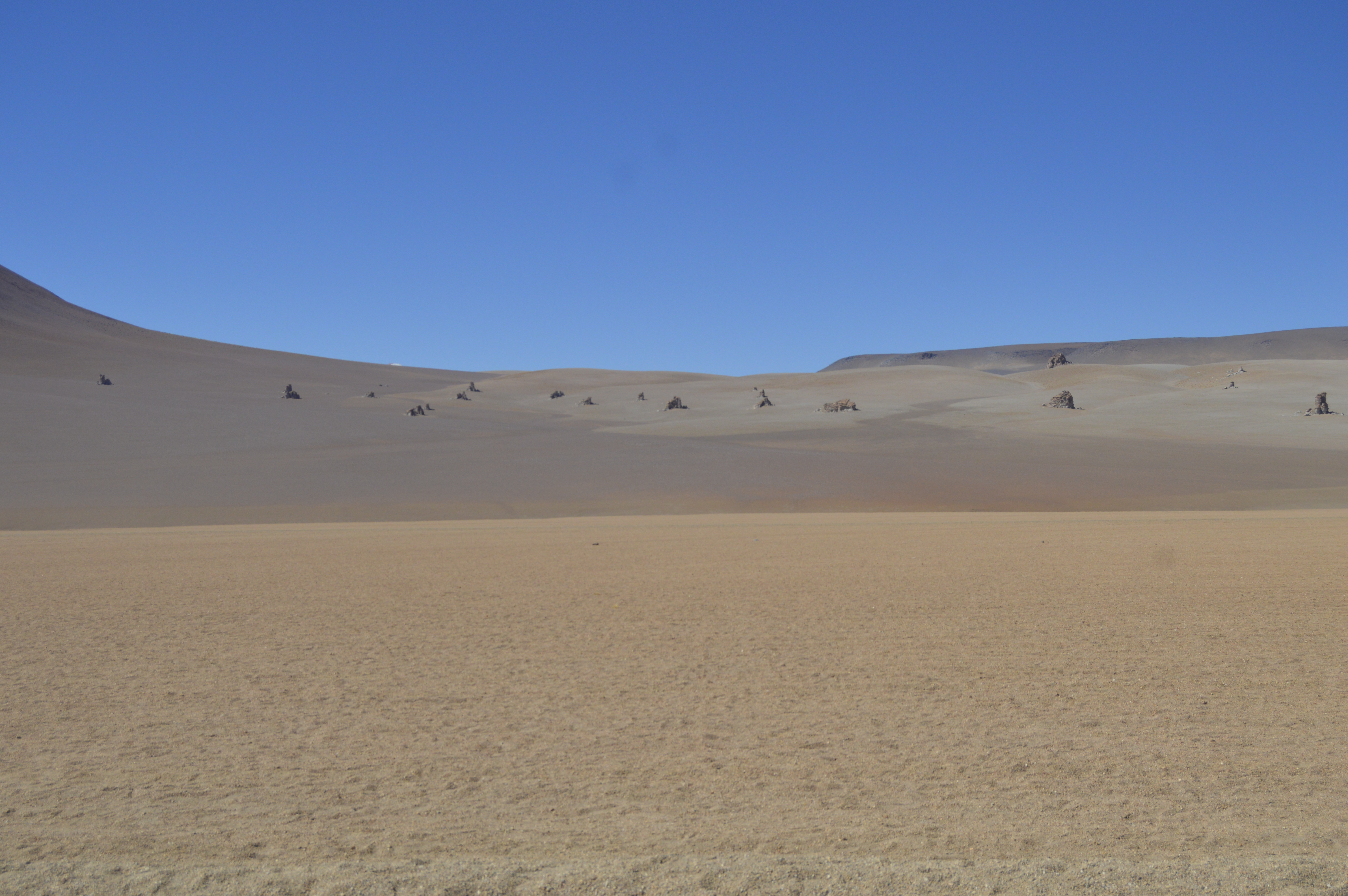
Dalí Desert

How Did Those Rocks Get There?

This slideshow requires JavaScript.

We settled into our hostel for the night – all 6 to a room! Our companions gave us the “matrimonial” bed – two twins pushed together – but it was so cold in the unheated hostel at over 15,000 feet that Matt and I snuggled into one twin bed to keep warm.

Next Up – Rocks, fox and more!

Cruising the Galapagos

Kicker Rock

Kicker Rock

Last week Matt and I were lucky to be on board the Lindblad Expeditions/National Geographic Endeavour for a week-long cruise around the eastern Galapagos Islands. We found out late Thursday that we were approved for the trip and set off early Saturday morning to San Cristobal to meet up with the ship. The 2 1/2 boat ride was rough and despite dramamine and my handy pressure point wristbands,  I learned a new meaning for walk of shame – walking off the boat with a puke bag in hand. Thankfully, I had prescription scopolamine patches left behind by some friends and slapped one on as soon as we got on board. We were ready to cruise!

We had only been on one cruise before – Alaska’s inside passage on a ginormous ship – and to say it was not my favorite vacation is an understatement. In addition to getting seasick, I did not enjoy the canned feeling of a sedentary voyage that catered to middle America tastes. What a difference this experience was! The fact that it was not a cruise but an “expedition” set the tone. Our schedule was packed with hikes, snorkeling trips, kayak outings and the like and led by naturalists who had a passion for the wildlife and setting. The passengers were primarily adventurous, active folks who were eager to learn about the Galapagos and see as much as possible. That said, we still had ample meals and time to relax. Sunset at the equator is 6 pm, so we were always back on board relatively early, particularly given that the ship doesn’t dock anywhere but instead uses zodiacs (hard bottomed rubber boats) to transport us between the ship and shore (or kayak or snorkeling spot). Getting between the ship and the zodiac is not always an easy feat in choppy waters. On the pier in San Cristobal some of our fellow passengers quickly set up a pool – $20 per person with the pot going to the first person unintentionally to go overboard during the transfer. Never one to pass up a gambling opportunity, we were in. Surprisingly, while there were some close calls, no one went overboard.

The magic of the Galapagos is its wildlife. While neither Matt nor I are birders, the birds proved to be fascinating on this trip. The first treat was seeing the waved albatross engaged in their mating dance on Española Island. This is not the normal mating season, and we saw some unusual animal activity on the trip, which our guides attributed to El Niño.

Albatross mate for life and each season lay one egg on open ground. Both partners incubate the egg and caring for it includes rolling it around. We didn’t see that spectacle, though I was hoping.

Hmmm

Hmmm

Next up were the Nazca Boobies. These are the largest of the 3 booby species found on the islands. The juveniles spend considerable time practicing to fly before they learn. They also are heavier than the adults (typical teens) and have to slim down before they can get airborn.

It is a bit hard to tell mating behavior versus fighting, but these two were having a turf war, much to the interest of their neighbors.

Not to be outdone, the Red Footed Boobies are pretty spectacular and should be called the Multicolored Beak – Red Footed Boobies.

Of course, the ubiquitous Blue Footed Boobies were also spotted.

We didn’t just bird watch. Matt’s favorite part of any trip is the snorkeling and we went on all 6 of the snorkeling excursions offered.

Unfortunately, on our second outing we got water in the camera. After trying to dry it out for a day we plugged it in to charge the battery and returned to our cabin a couple of hours later to find the cord melted into the camera. We were relieved we didn’t burn down the ship. We especially wished we had the camera for our snorkeling outing to Bartolomé. Often cited as the best of the islands, it did not disappoint. We saw just about every type of fish, coral, and sea creature (with the exception of sea turtles, penguins or sharks) that we have ever seen in the Galapagos and the structure around which we swam was fantastic. In the picture below, we snorkeled from the beach on the right to the end of the point with the peak.

Bartolomé Vista

Bartolomé Vista

We had a human-focused excursion to Post Office Bay on the island of Floreana where we continued a mail swapping tradition that dates back at least to 1793. The guides open the mail barrel and read out the addresses on the postcards inside. If one is close to your home, you take the postcard and deliver it in person. We took a few from the Milwaukee area although the recipients will have to wait until next year for their special delivery.

Back on the zodiac, a naturalist spotted some penguins so we zipped over to take a closer look.

Other adventures included searching for elusive land iguanas on Cerro Dragon on Santa Cruz (our home island – Matt actually went to school to give the tour for the passengers and I went home and did a load of laundry the first day we were there).

We saw the cruel side of nature: the kleptoparasitic frigatebirds that steal food from other birds by attacking them and shaking them by the tail and starving sea lion babies whose mothers likely were eaten by sharks.


Cruel Side of Nature

Heartbreak

We learned to look past natural camouflage.

And to enjoy the flamboyant.

Flamingo Bay

Flamingo Bay

There was something great to see every time we looked.

This slideshow requires JavaScript.

A trip to remember and a new appreciation for cruises!

To the Beach (Vacation Part V)

We left the dunes of Huacachina and hit the beach, specifically, Paracas, which is where Limeños (folks from Lima) go for a beach vacation.  We were at the beach but still in a desert, which just seemed off – water on one side and then endless sand on the other.  We stayed at Villa Kite, a beachside B&B owned by Jorge, who was an excellent host, spoke perfect English, and is the guy who brought kitesurfing to Peru.  Villa Kite provided us great views and daily walks as it was about 2 miles from the main drag in Paracas.

The walk was great – we went past beautiful multimillion dollar homes, saw tons of birds and enjoyed the ocean.  But then, as if to remind us that we are not in the US, was the stench.  We noticed it the first night when we stopped to have a drink at the swanky Paracas Hotel.  Despite the gorgeous surroundings, we gagged on the putrid odor.  We later asked Jorge and he confirmed that the town has grown too quickly and the sewer infrastructure isn’t up to par.  Wow, in the US you would not have multimillion dollar homes or $350 a night hotel rooms in an area that smells so vile.  Thankfully, Villa Kite was far enough from town and set back from the beach so that only once did we get a whiff of the sewage. The other downside of the beach was the stingrays and jellyfish.  The stingrays are always present, but a jellyfish bloom had occurred about 2 weeks prior to our visit so the ocean was teeming with them and when the tide went out hundreds would wash up on the beach and die.  No swimming for us on this beach vacation!

Paracas is what I imagine Door County, WI, was about 30 years ago.  The boardwalk is small and dotted with tsotchke stands and mediocre restaurants.  It was quaint in a rustic, Peruvian way and 5 days was enough time to sightsee and relax.

Matt set off in Jorge’s kayak one morning.  He had such a great time (once he got over the fear of tipping over into the jellyfish) that a couple of days later we rented kayaks.  How incredible!  We paddled across the bay and along the shoreline of the Paracas reserve.  The colors were just amazing – bright blue water, even brighter blue sky and glowing yellow sand.  The highlight was the flamboyance of flamingos that we saw.  (As an aside, isn’t the word “flamboyance” just perfect to describe a group of these flashy birds? Kudos to whoever came up with that one.)  There were probably 50 Chilean Flamingos, including gray babies.  Their pink plumage was so vibrant, much more than that of flamingos at the Milwaukee County Zoo.  We saw many other birds, and kept our eyes open for dolphins, but we didn’t spot any. (No dry bags = no pictures 😦  )

Next : Ballesta Islands, Paracas National Preserve and the Incan Ruins of Tomba Colorado