2,000 Books and Growing – Library Project Update

As I previously blogged about (here https://kerryedwyer.com/2015/07/10/one-book-at-a-time/, here https://kerryedwyer.com/2015/08/20/power-of-social-media-kindness-of-strangers-500-books/, here https://kerryedwyer.com/2015/09/25/open-for-business/ and here https://kerryedwyer.com/2015/11/01/the-kindness-of-strangers-part-ii/), my volunteer project in the Galapagos is to create and maintain a bilingual library for the Tomas de Berlanga school. In 8 months, we have made a lot of progress.

This is what the library looked like when I started the project in June:

Dumping Ground

Dumping Ground

We built and unveiled a new library with 900 books on September 24, 2015:
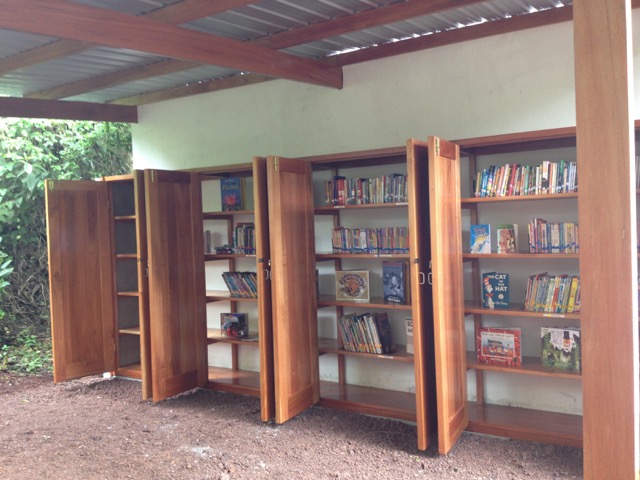
The New Stacks

The New Stacks – Room to Grow!

And closed the library for the school year last Friday:

Fabulous Volunteer About two weeks after the library opened, the school welcomed a volunteer from Germany, the amazing Helena. In addition to being hard working, fluent in English, friendly and kind, Helena is mature beyond her years. Helena’s help was crucial as we embarked on changing the school culture from one with limited reading and no accountability for the books to one with a fully functional library. Between the two of us, we were able to keep up with the indexing and labeling of donated books, have the library open 3 days a week and provide set library times for all of the classes.

Library Accomplishments In the 4 months the library has been open, we:

  1. More than doubled the number of books in the library to 2,075 books.  1,790 books are in English, 267 books are in Spanish and 18 books are bilingual.
  2. Manually checked out 972 books to students and 115 books to teachers.
  3. Held story hours with pre-school, 1st, 2nd and 3rd grade classes.
  4. Increased the number of teachers using the library from 2 to 12, including all of the English teachers.
  5. Trained the students on proper library conduct: checking out and returning books, shelving books, appropriate book handling.

Fundraising In addition to the on-site work, we continued working to obtain books and other resources for the library. In November, through the efforts of Hector Viela and Amy Torres, we started a GoFundMe campaign that raised $725. https://www.gofundme.com/wa6skk5z. We have spent about 1/2 of the funds to buy library materials and to mail books that Amy continues to collect for us in the US. The remaining funds will be used to build seating for the library once we have enough raised to commission some tables and benches.

Book Donations We continue to receive book donations from friends in the US. Thank you Tanya Oemig and Candy Underwood for mailing books to the Galapagos! Matt and I also brought back 100 pounds of books from a weekend trip to visit our family in NYC. Thanks to Mick, Andy, Tom and Sue for collecting these books (and Mary Ziino and Bridget Paul for their donations) and bringing them to us in NYC. Galapagos visitor Alex Doubek kindly brought some books from his collection when Mick put us in touch before his trip. Amy Torres also was able to deliver another 84 books to us via Pablo Weaver and his students from the University of La Verne who came on a study trip to the Galapagos. Amy is visiting us again this summer, this time bringing her daughter, more books and her never-ending support!

We also received donations from the school community. A school parent and labeling volunteer, Jessi Pfeltz Mahauad, donated 50 books when her family returned to the US. A 6th grade student, Lymin, took it upon herself to donate books she had read or outgrown, and additional parents have donated some books from their collections as well.

Lindblad Expeditions-National Geographic Bring a Book Program Visitors from the Lindblad Expeditions-National Geographic ships are invited to visit the school as one of their on-shore expeditions. Every time Matt led a tour, the tourists bemoaned the fact that they hadn’t brought books to donate to the school. Some were kind enough to mail books after their trip. The Lindblad Expeditions-National Geographic fund is also a generous donor to the school via student scholarships and an invaluable school supporter. Through conversations spearheaded by school parent and Lindblad employee Emma Ridley, we launched a “Bring a Book” program for Lindblad Expeditions-National Geographic travelers. Those who wish to support our library can bring a book or two of their choice or select books from an Amazon wish list (https://www.amazon.com/gp/registry/wishlist/2OPJUUA6G2N4D). I constantly update the list to reflect the gaps in our collection as well as specific requests by students and teachers (although I nixed one student’s request for a World of Minecraft manual).

While our other book collection efforts have yielded great books, mailing books is cost prohibitive and takes several months, while transporting large quantities of books from the US is inconvenient and burdensome for the traveler. Through the Bring a Book program, folks can bring one or two books, nothing onerous, and we get a steady stream of needed resources. In the first 2 months of the program we received 370 books! When the library opened, our limited book supply meant that students could only take out one book at a time per language and teachers were limited in the books they could check out for classroom use. Due to the new books, we will be able to increase the checkout limit and provide more books to the teachers.

Community Value While the library patrons are limited to the school community, the impact goes beyond our students. One 6th grade student consistently took out a picture book in Spanish to take home to read to his younger sister. A teacher also checked out books to read to her young child. It is exciting that the resources are being used to instill a love of reading in children who are too young to attend school.

Thank you to everyone who has supported the library project. It has been exactly what I need. I find island living extremely challenging: isolating, limited and lonely at times. Reading is my passion and to turn that into an on-going volunteer project that engages me is a win-win for me and the school.

Ringing in the New Year

Happy 2016 to All! I am all set for it to be a fantastic year because I participated in all of the Ecuadorian superstitions/traditions in order to ensure luck, prosperity and love (hot sex too, according to some). I collected everyone’s advice and on December 31, I was ready. My lovely German volunteer, Helena, was on board with me to make 2016 a year to remember.

First up, yellow underwear.

Yellow Underwear

Shopping for Luck. Or Hot Sex.

I first heard that one wears yellow underwear for luck. I don’t own yellow underwear (TMI?) but while out shopping on New Year’s Eve came across this display and thought, “why not?” I was all set when we headed out for dinner with some friends on December 31 until one friend told me that you couldn’t wear the underwear early but had to change into it at midnight. Umm, we planned to be in the main square watching fireworks (and eating grapes, but that comes later) at midnight, so I opted to ignore this additional caveat. Another friend who heard of our tradition quest asked about the yellow underwear, but she told me it was to ensure a year of hot sex and that the underwear had to be new and a gift. However, she said wearing it all night was just fine. As my underwear was new and Matt had pulled the money out of his wallet to pay for it and our other purchases, I am all set for a year of luck and/or hot sex.

Wearing red and green. Red is for love and green is for health. Which one to pick? If I don’t wear red, will Matt run off with an 18 year old Galapagueña? But health is top of my list as I get older. I opted for a shirt with red in it and green earrings, thus covering both bases. Matt stuck with plaid shorts that had a thin line of green, so apparently he is not concerned about me running off with a hottie surfer. Helena covered all of the bases with patterned underwear with red, yellow and green.

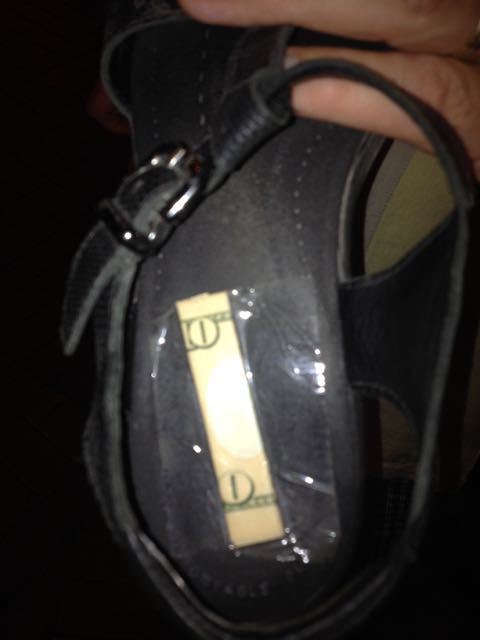
Money in one’s shoe to bring a year of prosperity. This was a problem as I wear sandals here. A little tape and I was set. A cabbie had told me $10, so I went with that figuring I didn’t mind losing $10 if the tape loosened.

Money in Shoe

Ready for Prosperity

Once again, caveats were added by a friend – LEFT shoe and it was better on the sole. Also, the bigger the bill the more prosperous, according to some. We were already out so I did a quick adjustment with my 10 spot.

LEFT shoe!

LEFT sole!

Change jingling in one’s pocket is also said to bring prosperity. I put change in BOTH pockets and fully expect to win a big lottery jackpot this year. (Note I did not say “win the lottery” as I do not intend all this effort to result in me winning a measly $2 in the Powerball!). Helena was equally committed and changed out of her cute, pocketless skirt into shorts with pockets.

Jingle Jangle

Jingle Jangle

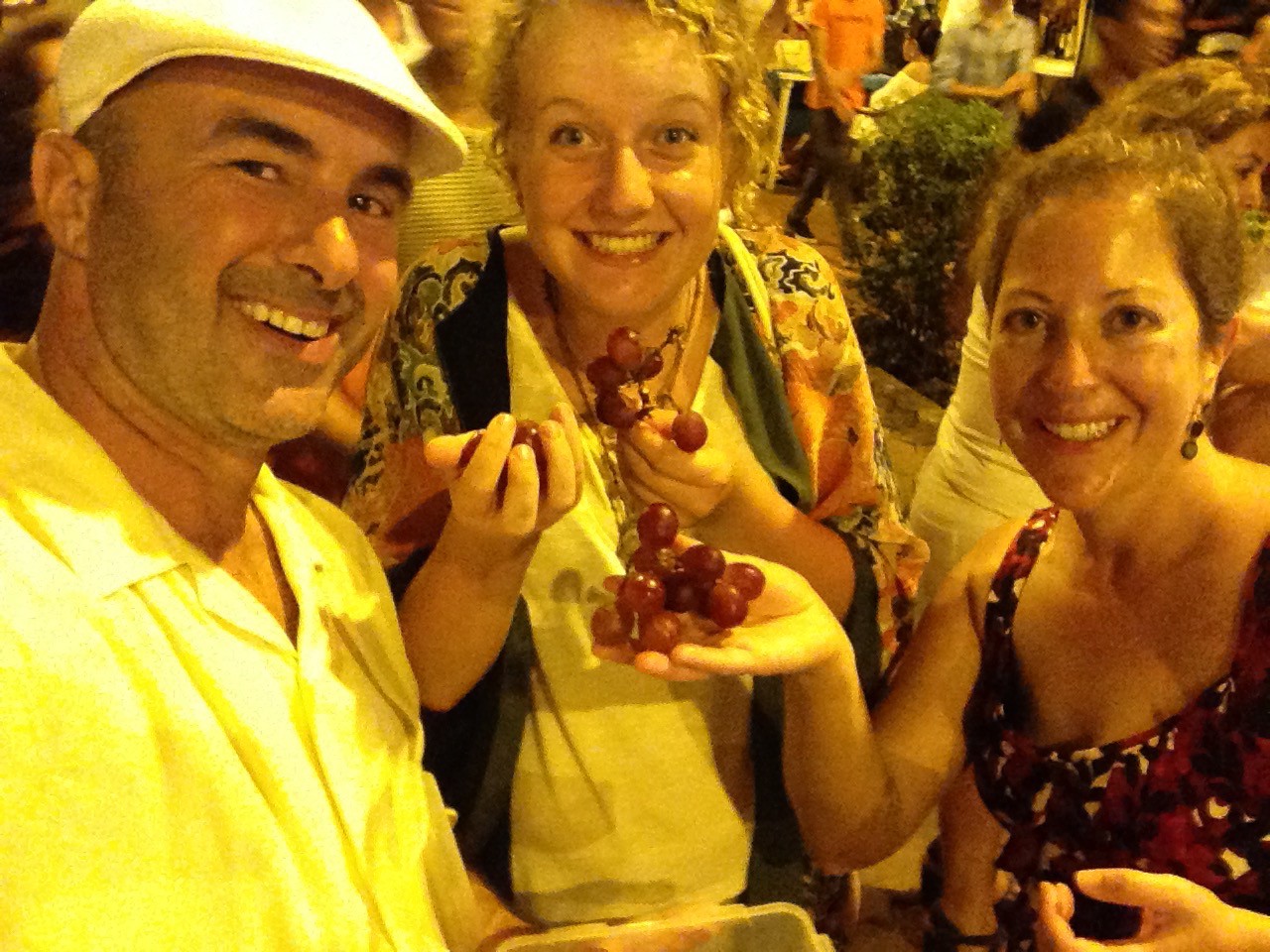
My final tradition was to eat 12 grapes at the stroke of midnight, while making a wish for each month. I gave it a shot but could only find large, seeded grapes on the island and it took me about 3 minutes to eat 12 of them. Maybe my January wish will come true? Matt and Helena did a much better job.

12 Grapes at Midnight

12 Grapes at Midnight

I contemplated another tradition to ensure a year of travel: pack a suitcase, carry your passport and run around your block or neighborhood at midnight. The farther you run; the farther you will travel. I decided to skip this one because my passport is with our attorney in Quito for visa paperwork, we live on an island and won’t have much opportunity to travel this year, and we planned to be in the square at midnight. Helena really wants to travel this year and was stuck with a dilemma until another friend said it was adequate to pack your suitcase and leave it by the door of your house and that your passport was not needed. Others questioned this modification, but he said that he did it twice and one year spent considerable time in Colombia and the other year spent 3 months in the US. We stopped at Helena’s house so she could pack her suitcase, and I hope she has a fantastic year of travel.

Another tradition is for men to dress up as the widow of the old year and beg for alms. During the day, Matt and I saw about a dozen such widows. He and our friends decided that they will participate in this tradition next year, so size 13 heels and a wig are now on our to-buy list for the US!

The night was a lot of fun with people out and about, effigies (Año Viejo or Old Year) that were burned at midnight, music and fireworks.

The effigies were a bit confusing. Why were people burning cartoon characters or the Pope? Especially the Pope tableau with the army figures where the Pope was labeled the “Pope of Peace” in obvious contract to the tank and soldiers.

Others were easier to understand although we needed the political one explained to us. We got the significance of the President (fair game on New Year’s Eve to poke fun at him), but the animal was a sheep representing his unquestioning followers and the sandwiches because he apparently gets supporters to events by giving out food.

All in all, a fun celebration and a good start to 2016. I can look forward to luck, love, health, prosperity, a wish or two and hot sex!

An Early Christmas: 48 hours on U.S. soil (with a stop in Guayaquil)

Matt and I were prepared to spend our first Christmas away from Wisconsin since embarking on our international adventure. It had been a long 7 months primarily on the island, but Matt isn’t off school for an extended amount of time until the end of February. Even when he was headed to New York City for a long weekend on business, I was planning to stay behind. Then my family offered to fly out to NYC for an early Christmas with us and I couldn’t resist. Plans were quickly finalized, including a visit with Matt’s mom and sister, and our whirlwind weekend was upon us.

Direct travel from the islands doesn’t really work, so we spent a night in Guayaquil, Ecuador, before heading to NYC. Guayaquil is the largest city in Ecuador and its banking and commercial hub. We had heard horror stories about Guayaquil and were given the usual warnings to be extra careful because the city was dangerous.We were pleasantly surprised. We stayed in a lovely hotel right across from “Iguana Park” (formally named Parque Seminario) and the Cathedral and a few blocks away from the delightful Malecón 2000 or river walk.

You would think that iguanas lose their appeal when you live in a town filled with them, but they don’t for me. I find the dragon-esque creatures to be equally fascinating and hilarious. Iguana Park was filled with land iguanas, a relative of the marine iguanas in Puerto Ayora. There were easily hundreds of them all over the park. We admired them and the turtles and koi in the pond. Early the next morning we went for a walk before our flight so I could visit the iguanas again and… no iguanas! Matt and I were mystified: where the heck did they all go? We wandered about and Matt teased that they were brought in for the tourists every day and shipped out at night. At one point I stopped under a tree in the lilac family to enjoy the sweet scent. We continued walking and I joked “what, did they all climb up to sleep in the trees at night?” We looked up – Yep!

We headed to the airport and our only excitement there was that one of our bags was flagged for a narcotic check so Matt had to go in the secret room for that process. As you can see, he didn’t look nervous due to a clean conscience.


Narcotic Check

Narcotic Check

At 8:30 pm we landed in New York, whizzed through immigration and customs and were in Manhattan at the house my family rented by 10 pm. Mick and Andy were out picking up our requested Indian food for dinner and Tom, Sue and Shannon had managed to stay awake to greet us despite being up at 4 am for their own flight. We visited into the wee hours until Mick, Andy and I finally called it a night at 2:30 am. The next morning we were able to have breakfast together before Matt headed to his meeting, Tommy, Sue and the kids to the Rockettes show and Mick, Andy and I for a walk alongside Central Park to the Metropolitan Museum of Art.

We reconvened in the late afternoon at Times Square, walked around bit and caught the first of many subway rides back to the house before dinner at Paola’s, a delicious Italian restaurant, and a nighttime visit to the Empire State Building.

The next day we took the Staten Island Ferry to get a view of the Statue of Liberty and Manhattan. It was a gorgeous day – more like September than December – and the trip was warm and sunny.

Marilyn and Jenny flew in that morning in time to meet us for a late lunch at Katz’s Deli, made famous in When Harry Met Sally. While the scene was chaotic, it actually was a pretty efficient operation considering the crowds.

One last stop before heading back to the house for final packing and our trip to the airport: Rockefeller Plaza and St. Patrick’s Cathedral. The crowds were intense, but seeing the skaters and tree was worth it.

5:30 pm and we were back in a cab for our 8:45 flight to Ecuador. A whirlwind trip but worth every minute!

Merry Christmas and Happy New Year!

Merry Christmas and Happy New Year!

Eating Grubs and a Death Defying Swim – The Amazon Part II

Why was I swimming in a lake with caiman, electric eels, anacondas, piranhas and arapaima, ginormous 200 pound, 9 feet long fish?

The Final Stretch

The Final Stretch

Because Matt wanted to do it and, if he was going to do it, I wasn’t going to chicken out. The plight of the youngest child.

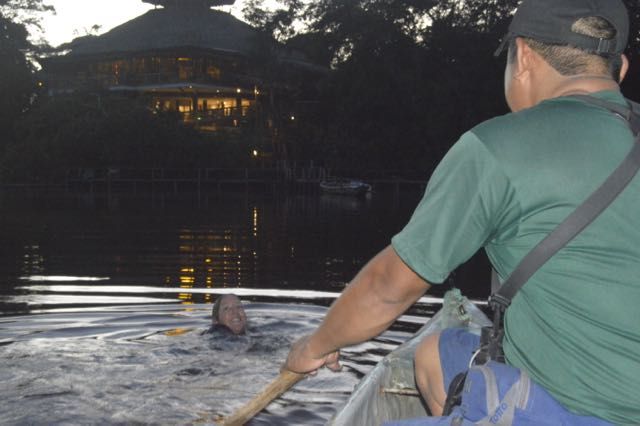
Rodrigo assured me that it was safe and that all of the aforementioned animals were “shy” and wouldn’t want to eat me. I was skeptical and the fact that I had seen another tourist catch a piranha off the very pier we were swimming to made me question my decision. Matt and I negotiated where we would jump in – Matt wanted to swim half of the lake and I wanted to swim about 10 strokes. Negotiations completed with a mid-point, Matt and I each slid off opposite sides of the canoe and I started swimming like crazy, all the while yelling at Matt to hurry up. I noticed that Rodrigo had an anxious look on his face when we first got in the water, but I just swam faster. Matt apparently thought that I was lagging behind and was swimming leisurely until our friends informed him that I was way ahead and it was a race. We arrived at the pier in a photo finish. I asked Rodrigo why he looked nervous and he said that as I got in the lake one of the arapaima had jumped right in front of me and he was afraid I would panic if I had seen it. How right he was!

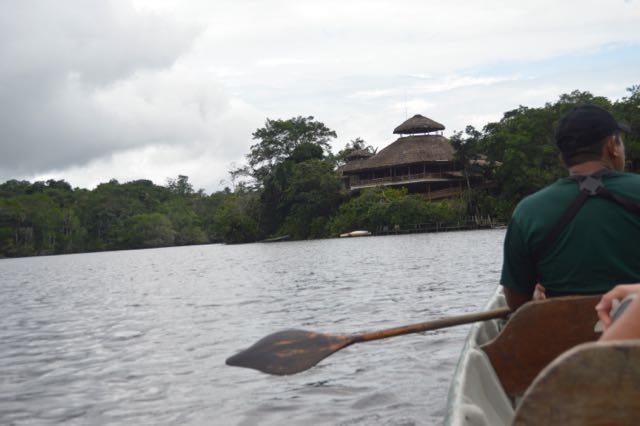
The next day we took a picture of where we had started our swim. Pretty impressive distance, I think.

Swim Distance

Swim Distance

Earlier in the day, our excursion was to an indigenous Kichwa community, Sani Isla. I approached the tour with some trepidation because I worry that these types of tours make a spectacle of people, as if they are zoo animals to be observed and oohed over. Matt and I talked about it and he pointed out that his school is now part of such tours and that he and the other teachers and students welcome the tours. That made me feel better.

The women of the community established a cooperative to better their lives and are part of a larger organization that is designed to improve the lives of indigenous women and allow them to continue their traditional way of life. They make jewelry and other trinkets, give tours of their community area and prepare some traditional food for the tourists to enjoy. The cooperative is run by the woman through an elected board. The women rotate the duties at the community area, which can be a couple of hours walk from their homes. When we visited, there was a meeting occurring so there were many woman and children at the site. The site also contains the local elementary school that was even less resourced than Tomas de Berlanga. I wished we had known so we could have brought some books or other items.


We walked around the grounds and saw the plants they raised: papaya, pineapple, yucca, plantain, cocoa, coffee and more. These are the typical plants that each family would have around its house. Rodrigo was intent on showing his indigenous skills and shimmied up the tree to pick us a papaya. While I normally do not like papaya, this one was delicious.

After our papaya snack, we went to the cooking area to see the traditional cooking style and taste some food. Rodrigo explained the various items on the grill: fish with palm hearts cooked in leaves, grilled nut of some kind, plantains and grubs on a stick. Yes, Grubs. He showed us the fat, squirming live grubs

Live Grubs

Live Grubs

Ripped one in two,

Ready to Share a Grub

Ready to Share a Grub

And challenged, er, invited, one of us to share the now-oozing, bloody grub with him. We stood there, aghast, each hoping someone else would be a sport and just when Rodrigo’s eyes lit upon Matt, Sally volunteered. Talk about taking one for the team! I gagged the entire time as I watched her fabulous expressions as she chewed and chewed and finally swallowed the grub.

Sally Taking One for the Team

Sally Taking One for the Team

“I was okay until I got to the bum, which was squishy,” was Sally’s verdict. After that, I felt I would have been a poor sport not to eat a grilled grub, so I quickly grabbed the smallest one on the skewer. Truth be told, it did not taste bad and had a smoky, bacon flavor, but it was hard to get particularly after I had just seen a raw one eaten.

The rest of the food was fine. While Matt and I have grown accustomed to being served fish with its head still attached, we still are squeamish about it. Rodrigo happily ate seconds and thirds of everything we didn’t want, and with more gusto than he ate at any of our meals at the lodge, which confirmed that this was an authentic meal and probably one he preferred over the Western-style food the lodge served.

Our last activity at the community center was a shake down to adopt some turtles and release them into the river. I am not entirely convinced that these same turtles aren’t caught every week to be adopted by some other tourists, but played along all the same. I named my turtle “Wisconsin,” Matt named his “Ky” and Arturo named his “Kerry,” which I chose to see as a compliment regardless of whether it was! Stephen was traumatized when his turtle kept going the wrong way and almost got run over by our boat. Not sure that one is going to make it.

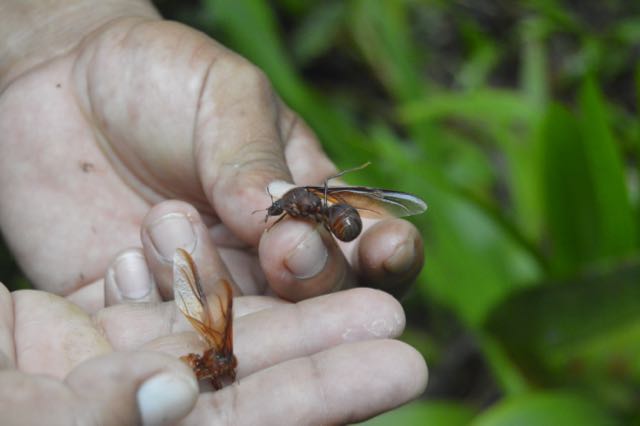
The grub wasn’t the only interesting insect we were offered to eat. The next morning, when Matt and I were the only two in our group until the new tourists arrived, Rodrigo was excited to find these flying ants and encouraged us to pop off the abdomen (back part) and eat it. We declined and he ate them with relish.

Sloth - 1 (52)

Tasty Snack?

We did, however, try the teeny-tiny lemon ants, nicknamed because they taste like lemon. I had eaten ants before when my 9th grade biology teacher, Mr. Alvarez, had a day when we ate ants, worms, bullheads and cattails to show us that what we consider food is subjective. At least I think that was the point. And how to survive if you were lost in the wilderness, I suppose. I thought the ants were delicious and went back for seconds, meaning I walked over to the tree they lived on and waiting for some more to crawl on me before licking them off my arm. When in Rome…

Enjoying Lemon Ants

Enjoying Lemon Ants

The other highlights of the trip included the cool mushrooms:

The search for sloths, which Sally was on a hunt to see. We saw both 2 and 3 toed sloths from a great distances:

Sloth from a Distance

Sloth from a Distance

Cool insects, which we did not eat:

Neat frogs:

And my favorite, the stinky turkey. It’s real name is the hoatzin and its key features are that it is stinky, tastes like a bad turkey, and makes a noise like a labrador retriever panting on a hot day. That said, it is really quite pretty.

The last night this fellow made an appearance in the stockroom under the lodge.

I didn’t sleep very well that night. I had noticed that the pillar holding up our cottage, which was also part of the bed frame, was open around it and all night I imagined a boa constrictor slithering up besides me. While I half-wanted to see an anaconda on the trip, I think the boa constrictor was sufficient.

All in all, a nice getaway from the island. I’m glad we went and had a great time, but once in the Amazon is probably enough for me. Next time, that caiman might just get me!

Welcome to the Jungle – The Amazon Part I

We ran out of time in Peru and never made it to the Amazon, so for Matt’s first scheduled vacation, we booked a trip to the Ecuadorian Amazon. Called the jungle and considered a rainforest, both descriptions are apt. We were in the Amazon basin, but the Ecuadorian lodges are on tributaries of the Amazon, something Matt was disappointed to learn.

Matt in the Jungle

Matt in the Jungle

We wanted comfort, as much as there is comfort in the middle of the jungle, so we stayed at an upscale lodge, La Selva Amazon Ecolodge, just off the Napo River on Lake Garzacocha. After a short flight from Quito to Coca, we took a 2+ hour boat ride down the Napo. The big industry is oil and we saw many drill sites along the way.

After getting drenched in a downpour on the boat ride, welcome to the rainforest, we took a short walk, climbed into canoes and were paddled though creeks and across a lake before reaching the lodge. I was initially uncomfortable with 2 men paddling 6 additional adults around, but got used to it as we traveled that way throughout the trip.

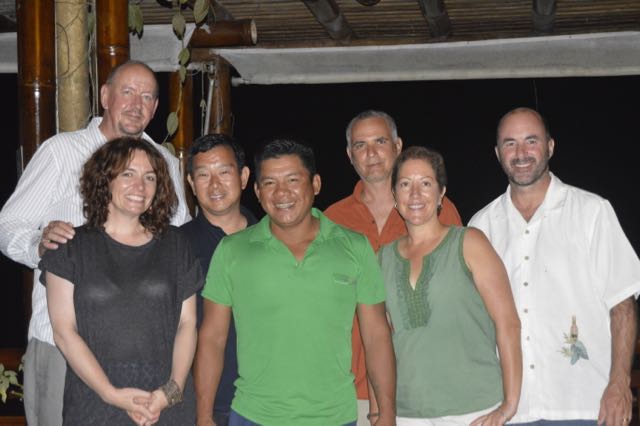
The grounds and accommodations were very nice and about as luxurious as they could be given the journey it takes to get everything there. Shortly after arrival, everyone was put in groups. Like summer camp, your excursions and meals are with the same people. We lucked out and were with a great group: Sally and Clint from England and Stephen and Arturo from the US. Because Matt and I stayed a day longer than the traditional 3-day stay, we were groupless at the end. It quickly became apparent that other guests perceived our group as the “good” group based on the horror stories we heard. We also lucked out with our guides, Rodrigo and Dario. Wildlife viewing in the Amazon is the opposite of wildlife viewing in the Galapagos: the animals hide in the Amazon as opposed to coming within centimeters of you as they do in the Galapagos. Rodrigo was our naturalist and Dario our native guide. However, Rodrigo was also the only naturalist who grew up in the Amazon rainforest. I think his skills in spotting wildlife came from hunting in the forest since he was a young child. He also liked to mention, with a gleam in his eye, how tasty particular species of monkeys are.

The Gang Minus Dario

The Gang Minus Dario

Our first excursion was a night canoe trip across the lake and followed by a hike. Nothing like jumping right into things: tarantulas, a snake and more!

On the way back we stopped to visit this sinister guy:

Caiman

Caiman

Matt and I were in the back of the canoe and couldn’t see him very well, but Arturo took a great photo for us.

Day 2 started with a 5 am wake up call to hike to the observation tower for an early morning of birdwatching. It was overcast, but we still saw many brightly colored parrots and other birds. Unfortunately, we saw most through a telescope so no pictures.

After a few hours, we hiked through the rainforest for a couple of hours. It was a peaceful walk through the forest although I could have done without rousing a tarantula from its lair.

We went back to the lodge for relaxation and lunch before our next hike. The highlight of this hike, and my favorite part of our entire visit, were the monkeys. We saw howler, wooly, pygmy marmoset, red titi, capuchin, squirrel, owl night and black mantle monkeys. My favorites were the appropriately named howler monkeys even though they woke us up every morning with their howling (the first morning we had no idea what the racket was) and the “monkey migrations,” particularly of the acrobatic squirrel monkeys, when countless monkeys would stream overhead. They weren’t always easy to spot, but after a few days we learned a little how to read the moving leaves high in the trees to know if it was wind or monkeys. Rodrigo loved the monkeys and made sure we saw the different varieties.

Listen to these with the sound on:

Next Up: Swimming with the piranhas, eating grubs, stinky turkeys and more!

The Kindness of Strangers Part II

The New Stacks

The New Stacks

Amy Torres learned about my library project for the Tomás de Berlanga school on the Galapagos Islands when I placed my blog post on the ALA Think Tank Facebook page. Amy and her husband were spurred into collecting and delivering 500 books to us in the Galapagos, something I wrote about here.

https://kerryedwyer.com/2015/08/20/power-of-social-media-kindness-of-strangers-500-books/

Welcome and Thank You!

Welcome and Thank You!

During their stay in Quito, Amy and Harry met Hector Viela. Although Hector has never visited the Galapagos and has no connection to the school, he was inspired by Amy and Harry’s mission and offered to help us by setting up a GoFundMe page to obtain donations. True to his word, our GoFundMe campaign went live today. If you have read about the library project and want to donate funds to help us, now you can! Any amount – $5, $10, $25 – will help greatly. My previous requests for assistance have resulted in many books being collected for us. Now we need to get the funds to ship them here.

https://www.gofundme.com/wa6skk5z

Thanks for any support you can provide. The students love the new books and will greatly appreciate any additional books we can get for them.

The 1/2 Way Mark


St. Paddy's Day

St. Paddy’s Day

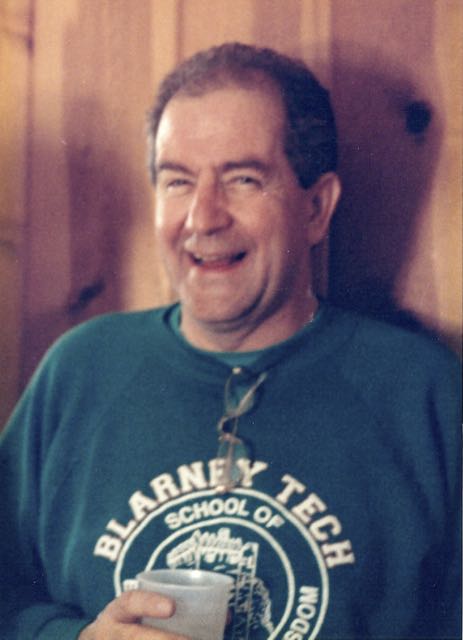
Life isn’t fair. If you grew up in my family and didn’t know this by the time you were 4 or 5, you weren’t paying attention. It was my dad’s favorite line. Complain about pretty much anything and you could expect, “Well, kid, life isn’t fair. Get used to it.”

Death isn’t fair either. 23 years ago, when I was 23, my dad died of lung cancer. He was 56.

I’ve been dreading this day, the symbolic halfway point of my life, since his death. In the year after my dad died, I took comfort in the fact that only one year ago, he was still alive. But as that horrible year after his death passed, I couldn’t think “last year he” or “last year we.” The last year was already gone.

Andy's Baptism, Last Family Photo

Andy’s Baptism, Last Family Photo

The immediate pain of death recedes. That’s true. But the loss remains. Not a day goes by that I don’t think of my dad. Not. One. Day. 23 years is a long time to miss someone.

And there is a lot to miss. My dad was not perfect, but boy, he was fun, the life of many parties. He would accept any last minute invitation and leave the chores for later. He taught me to swim, fish, ski, golf, shoot a basket (I never really learned that one), swing a bat, and ride a bike. There were family ski trips with the Arpins and, once, an infamous canoe trip with my uncle and cousin. He taught me to play cribbage and gin rummy and that there always needed to be some stakes (1/10 of a penny a point when I was really little) to “keep the game interesting.” He did not let me win. Ever. He taught me Irish songs, many violent or morbid, and was the one to explain to my kindergarten teacher why I sang a song about “sticking a knife in the baby’s head” for show-and-tell. (His excuse was that I spoke [and sang] so quickly he didn’t think anyone would understand me.) He fostered my love for demented Christmas trees  because he and Pat Arpin would bar hop until they finally cut down the trees, leading to some interesting specimens that eventually became a family tradition. He hand wrote letters to me while I lived in Italy, which usually consisted of sports updates of the Brewers, Bucks, Green Bay Packers and the Wisconsin Badgers and a few tidbits of family news. The year between college and law school when I lived at home and waitressed, he would often wait for me to get home from my weekend shifts and have a drink with me while I unwound. When I was in law school, he always took me to the airport when I left and picked me up when I came home.

He loved me and I never doubted that love. I never had an absent or disinterested father. I was his “favorite youngest daughter.”

1988

1988

And now, it’s the 1/2 way mark. After today, I will live more of my life without my dad than I got to live with him. It’s not fair.

Except not really. I did the math: the halfway point is really in another 336 days. So for another 336 days I can take comfort in knowing that I got to enjoy life with my dad longer than I have enjoyed life without him. And after that, I will just have to enjoy life: it’s the only way to honor the memory of someone who loved life like he did.

Adventures in Cooking

I love to cook. Actually, I love to bake because I have a huge sweet tooth, but I enjoy cooking as well.

I told my sister how I was always cooking the same thing here due to fairly limited ingredients – chicken, fish or shrimp with a veggie side dish and the occasional hamburger. When Mick mentioned a chicken and artichoke dish our friend Chris made for her, I was excited because I had seen canned artichokes in the store. Mick passed along along Chris’ recipe that included Chris’ notes on how to improve the recipe: the type of artichokes to buy, additional mushrooms etc. As I made the dish, I thought that my Galapagos recipe notes would look a bit different. Here they are:
1. Take chicken that you had to skin and debone yourself out of the freezer to defrost. Place in microwave so the geckos and microscopic spiders that live in your kitchen don’t taint it. Write a note so you remember you have chicken defrosting in the microwave.
2.  See the note about 5 hours later, place the still-cool chicken in the fridge and pull out the recipe. Note you only have 1 can of artichokes and that you have only seen fresh mushrooms on the island 3 times in 6 months. Take out home-made chicken broth (added benefit of always having to buy bone-in chicken) from freezer to defrost.
3. Walk 3/4 mile to store in search of artichokes and fresh mushrooms. No fresh mushrooms at the store, but you are happy to find a can of artichokes. Snob (pronounced by native Spanish speakers as eh-snōb) brand because it is the only one. Debate over $4.65 can of eh-Snob mushrooms. Pass on it and then go back to get it rationalizing that you ate canned mushrooms on steak until you were about 16 and Mom started buying fresh ones.
4. Walk home 3/4 mile.
5. Start cooking and scream at the gecko you find licking the side of your chicken broth. Chase it around with the dedicated plastic cup and laminated award Matt’s friend gave him for his 2nd place fantasy football win that is now used to catch and “relocate” house geckos. Fail as it executes some incredible last minute leaps and you have been on vacation for a week and your trapping skills have suffered. Kick yourself for not defrosting the broth in the microwave but shrug and wipe down the side of the container.
6. Get out your pyrex from its carrying case. Note that the carrying case now has mold growing on it. Just like your purses, shoes, Matt’s suit jackets and half of the rest of the stuff in your house.
7. Wash the pyrex because even though it had a lid on it and was in its zippered case, what appears to be gecko poop is in it.
8. Turn on oven but look up the damn celsius to fahrenheit conversion that you can never remember.
9. Turn on burner but note that it is flaming oddly. Watch for rogue gecko as singed ones have run out of your burner in the past. No gecko appears. Carry on.
10. Continue cooking, smooshing any microscopic spiders you see because it is a lost cause and you have given up trying to eradicate them.
11. Keep cup and award handy for rogue gecko, but the little shit knows to stay away.
12. Hope that the cake flour, the only type you have been able to find on the island, means you will finally be able to whisk flour into broth without getting lumps. Fail yet again. Blame cake flour.
13. No sherry in town. Find some old white wine in the fridge that was too crappy to drink and kept for cooking. Smell it and add to lumpy sauce.

Enjoy!

Cruising the Galapagos

Kicker Rock

Kicker Rock

Last week Matt and I were lucky to be on board the Lindblad Expeditions/National Geographic Endeavour for a week-long cruise around the eastern Galapagos Islands. We found out late Thursday that we were approved for the trip and set off early Saturday morning to San Cristobal to meet up with the ship. The 2 1/2 boat ride was rough and despite dramamine and my handy pressure point wristbands,  I learned a new meaning for walk of shame – walking off the boat with a puke bag in hand. Thankfully, I had prescription scopolamine patches left behind by some friends and slapped one on as soon as we got on board. We were ready to cruise!

We had only been on one cruise before – Alaska’s inside passage on a ginormous ship – and to say it was not my favorite vacation is an understatement. In addition to getting seasick, I did not enjoy the canned feeling of a sedentary voyage that catered to middle America tastes. What a difference this experience was! The fact that it was not a cruise but an “expedition” set the tone. Our schedule was packed with hikes, snorkeling trips, kayak outings and the like and led by naturalists who had a passion for the wildlife and setting. The passengers were primarily adventurous, active folks who were eager to learn about the Galapagos and see as much as possible. That said, we still had ample meals and time to relax. Sunset at the equator is 6 pm, so we were always back on board relatively early, particularly given that the ship doesn’t dock anywhere but instead uses zodiacs (hard bottomed rubber boats) to transport us between the ship and shore (or kayak or snorkeling spot). Getting between the ship and the zodiac is not always an easy feat in choppy waters. On the pier in San Cristobal some of our fellow passengers quickly set up a pool – $20 per person with the pot going to the first person unintentionally to go overboard during the transfer. Never one to pass up a gambling opportunity, we were in. Surprisingly, while there were some close calls, no one went overboard.

The magic of the Galapagos is its wildlife. While neither Matt nor I are birders, the birds proved to be fascinating on this trip. The first treat was seeing the waved albatross engaged in their mating dance on Española Island. This is not the normal mating season, and we saw some unusual animal activity on the trip, which our guides attributed to El Niño.

Albatross mate for life and each season lay one egg on open ground. Both partners incubate the egg and caring for it includes rolling it around. We didn’t see that spectacle, though I was hoping.

Hmmm

Hmmm

Next up were the Nazca Boobies. These are the largest of the 3 booby species found on the islands. The juveniles spend considerable time practicing to fly before they learn. They also are heavier than the adults (typical teens) and have to slim down before they can get airborn.

It is a bit hard to tell mating behavior versus fighting, but these two were having a turf war, much to the interest of their neighbors.

Not to be outdone, the Red Footed Boobies are pretty spectacular and should be called the Multicolored Beak – Red Footed Boobies.

Of course, the ubiquitous Blue Footed Boobies were also spotted.

We didn’t just bird watch. Matt’s favorite part of any trip is the snorkeling and we went on all 6 of the snorkeling excursions offered.

Unfortunately, on our second outing we got water in the camera. After trying to dry it out for a day we plugged it in to charge the battery and returned to our cabin a couple of hours later to find the cord melted into the camera. We were relieved we didn’t burn down the ship. We especially wished we had the camera for our snorkeling outing to Bartolomé. Often cited as the best of the islands, it did not disappoint. We saw just about every type of fish, coral, and sea creature (with the exception of sea turtles, penguins or sharks) that we have ever seen in the Galapagos and the structure around which we swam was fantastic. In the picture below, we snorkeled from the beach on the right to the end of the point with the peak.

Bartolomé Vista

Bartolomé Vista

We had a human-focused excursion to Post Office Bay on the island of Floreana where we continued a mail swapping tradition that dates back at least to 1793. The guides open the mail barrel and read out the addresses on the postcards inside. If one is close to your home, you take the postcard and deliver it in person. We took a few from the Milwaukee area although the recipients will have to wait until next year for their special delivery.

Back on the zodiac, a naturalist spotted some penguins so we zipped over to take a closer look.

Other adventures included searching for elusive land iguanas on Cerro Dragon on Santa Cruz (our home island – Matt actually went to school to give the tour for the passengers and I went home and did a load of laundry the first day we were there).

We saw the cruel side of nature: the kleptoparasitic frigatebirds that steal food from other birds by attacking them and shaking them by the tail and starving sea lion babies whose mothers likely were eaten by sharks.


Cruel Side of Nature

Heartbreak

We learned to look past natural camouflage.

And to enjoy the flamboyant.

Flamingo Bay

Flamingo Bay

There was something great to see every time we looked.

This slideshow requires JavaScript.

A trip to remember and a new appreciation for cruises!

Open For Business!

Yesterday was the grand opening of the Tomás de Berlanga Open Air Library! In a few short months, we managed to build a new dedicated space for the student library, secure amazing donations of new and gently used books, cull hundreds of unsuitable books and label and index the remaining 900 books for the student library.

We went from this:

Conceptualized this:

To this:

The students were patiently awaiting the new library and getting their hands on the newly donated books. Finally, we were ready to open the English section of the library. (I need to finish sorting and labeling the Spanish books, but they are few in number and in even worse shape than the English ones were.)

I started checking out books right after we opened and had a steady stream of patrons the rest of the day. It was amazing! Students were coming during their recess and, I later realized, slipping out of class to come for a book. There was a lot of borrower’s remorse and requests to change books – I think the kids were so overwhelmed with the great new options that they didn’t know where to start. The cool, donated book marks were a big hit and the kids were amazed to find out they could keep them. We also have a lot of education to do about library procedures: starting with checking out books and not just taking them. As we have no computer for the library, the check out system is old school. It took me several nights to fill out a form for each student – they each have 4 names here and it is not always consistent which ones they use.

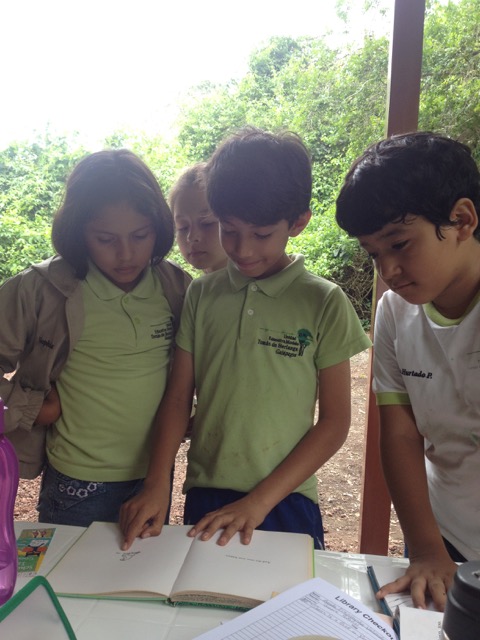
The best part of the day was when a few 5th graders came to the library during recess. One boy, Matias, picked The Giving Tree to check out and I told him it was one of my favorite books. Other kids chimed in and Matias started reading it at the checkout table. I asked if he wanted to read it aloud and he happily agreed. The other students gathered around and listened (shushing one boy who started reading his book aloud) and we all enjoyed the first story hour at the open air library.

Impromptu Story Hour

Impromptu Story Hour

A big THANK YOU to everyone who helped on this project, including

  • Matt for securing the funding to build the library
  • Corina Gallardo Nelson for designing the library and securing the contractors
  • Donna Daugherty and John Garate for securing the municipal donation of the lava rocks and machinery and man power to spread them
  • Paola Leguísamo and Martin Hoss for encouragement and assistance in getting the construction completed
  • Jo Browne for help with book labeling
  • Jessi Pfeltz for countless hours spent labeling books, making signs, and weeding books
  • Lisa Dell for giving up her prep time (and spare time) to index, label and weed books
  • Amy and Harry Torres for getting the donation ball rolling with a 500 book donation and Amy’s tireless library advice
  • Patty Wanniger, Sarah Wakefield and Maria Schmidt for wonderful library advice and suggestions

WANT TO HELP? WE NEED BOOKS!

  • Bring a book (or books!) on your trip to the Galapagos or send some books with someone you know who is traveling here. This is the least expensive way to get books here. Book guidelines are listed below.
  • Send books for the school from your home country. For US guests, the United States Postal Service is the most economical way to send books. Contact me for more information and the mailing address. If you are able to collect books for us but do not have the funding to ship them, my brother (in Wisconsin) has generously agreed to accept and coordinate book donations as we seek funding sources for shipping. Please contact me for his information.
  • Donate funds to ship books. US donors have collected books for the school, but the school does not have the funds to pay for shipping costs. For example, previous shipments from the United States were sent via USPS and cost $122 for a box of 40 books that weighed about 27 pounds and $80 for a box of 50 books that weighed about 18 pounds. If you want to donate, contact me and I will connect you with someone who has already collected books for us.

Book Guidelines:

  • Please collect new or gently used books that are interesting to children. Remember that English is a second language for our students. The school has an Amazon wish list with some suggested titles, but donors can ask a child what his or her favorite books are or talk to teachers, librarians or booksellers for ideas. While some books are great classics, many books that libraries are discarding are being discarded for a reason: they are dated and no one wants to read them. Library book sales, your own shelves and second hand stores are great places to look, but not every book needs a home in the Galapagos. The wish list can be found at: https://amzn.com/w/2OPJUUA6G2N4D
  • The school is pre-kindergarten through 12th grade and books at all levels would be appreciated. We currently have a special need for picture books (no board books please as their small size makes them difficult in the library) early readers and books at a 1-5 grade reading level. Multiple copies of books are welcome, as they would allow for a class to use them for a reading circle.
  • Books in Spanish are also appreciated. While we want to improve the students’ English proficiency, we also want to encourage a love of reading the their native language.
  • Gently used, please! Dust covers are not necessary, but scribbled in, ripped or grimy books are best discarded.
  • Coloring books, workbooks and sticker books are best for your local charity for a single recipient to enjoy, not for a school library.

For more information about the school, visit its Facebook page https://www.facebook.com/tdberlanga or its website at http://www.scalesia.org/tomas-de-berlanga-school